Challenge 1
Find every black line on the mat and trace it with your finger. Write down how many separate lines there are and which stations each one connects.
Quick Learn — the model, the instructions, the program and the challenges. The theory is in Full Lesson.
EV3 Robotics›Level 4 · WRO Prep›Lesson 1
Level 4 · Lesson 1 · EV3-L04-0160 minutes · Block 1 of 6 · Mat: WRO 2021 — POWERBOTS, Energy at Home
Welcome to Level 4. For the next forty-eight lessons you are not building models — you are building one robot that has to survive a competition, and rebuilding it six times for six different game mats.
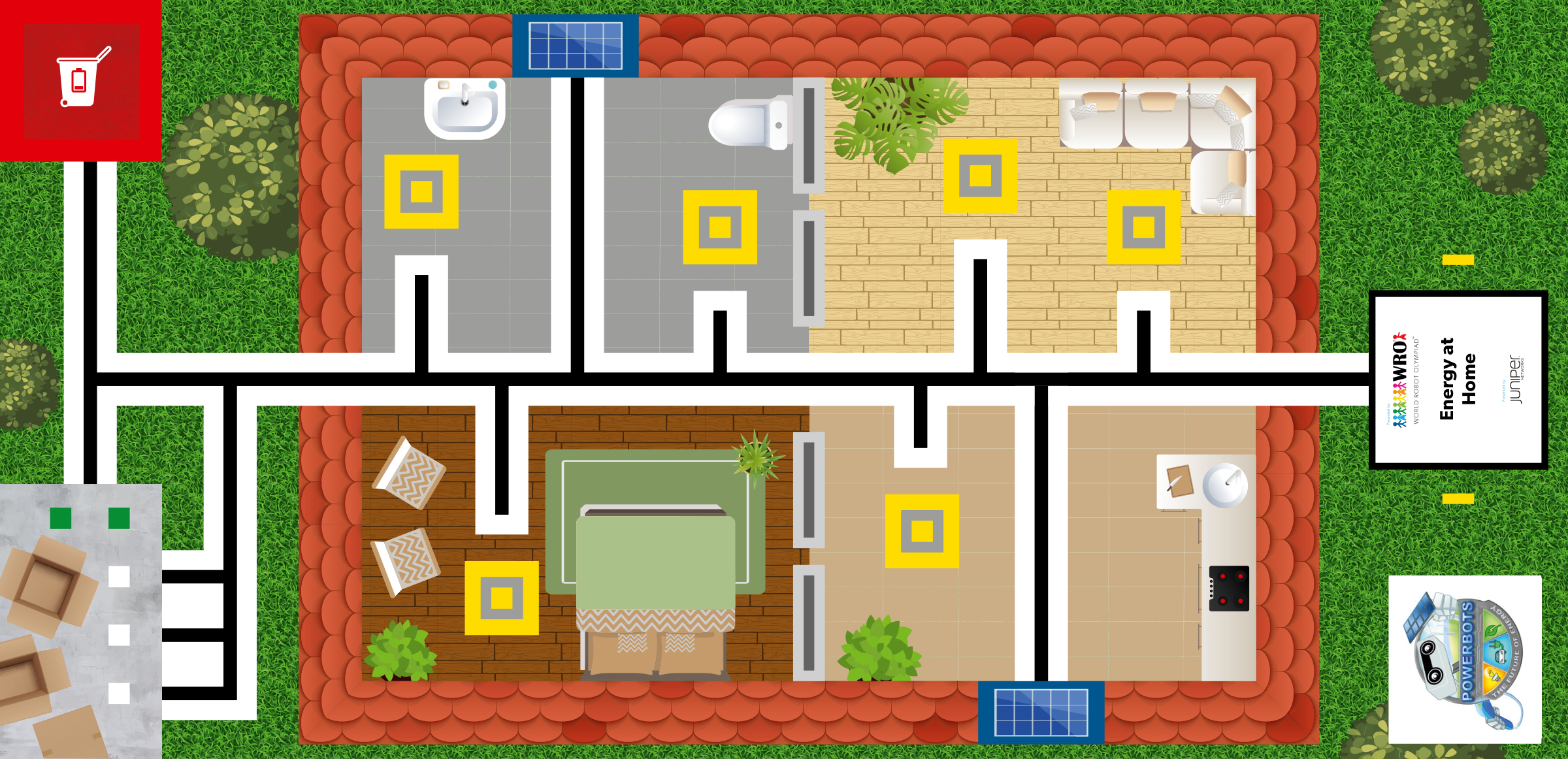
This block runs on the WRO 2021 RoboMission Elementary mat, themed POWERBOTS — Energy at Home. A house is drawn on the mat. Energy is being wasted in some rooms and generated in others, and the robot has to move energy modules to where they belong.
Today you will not touch a brick. That is deliberate. The fastest way to lose a WRO round is to build a beautiful robot that scores the wrong thing. Before anyone picks up a motor, the team has to be able to read the mat the way an engineer reads a drawing.
Why a whole lesson on reading? In a real round you get two minutes. There is no time to discover during the run that a module only counts when it is fully inside its zone, or that a line stops 10 cm short of the station you assumed it reached. Every one of those is written down somewhere before the round starts.
Your branch has its own printed copy of this mat, and the picker at the bottom of this page shows the one you are standing next to. Every mat in the Hub carries named stations rather than measurements, because a challenge that says “drive 45 cm” is wrong on somebody else’s copy.
The 2021 mat has seven named positions:
| Station | What is there | Why it matters |
|---|---|---|
| HOME | Delivery yard, bottom left, outside the house | Every run starts and usually ends here |
| A | Battery bin, top left, outside | Furthest point on the mat — the expensive trip |
| B | Bathroom | Tight approach, close to the wall |
| C | Living room (the sofa) | Wide open — easy to reach, easy to overshoot |
| D | Bedroom | Middle of the mat, reachable from three directions |
| E | Kitchen (the hob) | On the main line, so a good first target |
| F | Solar panel, bottom edge | Closest to HOME — where energy is generated |
Say the letters out loud as a team. For the rest of the block, “go to E” has to mean the kitchen to everybody without anyone pointing.
There are four passes. Do them in this order, and write as you go. Reading a mat is not looking at it.
Trace every black line with a finger. Note where each line starts and stops, and where two lines cross. A junction is a decision the robot will have to make, and a line that stops short is a place where a line follower will drive off into nothing.
Find every coloured square, circle and border. For each one ask the question that decides the points: does the object have to be touching, inside, or completely inside? Those are three different robots.
Missions are not worth the same. Write them in points-per-second order, not points order — a 15-point mission that takes 20 seconds beats a 20-point mission that takes 60. That ranking is your route plan, and most teams never make it.
Starting area size, whether you may touch the robot mid-run (and what it costs), the time limit, and what counts as a restart. These live in the rulebook, not the artwork, and they change what a sensible route looks like.
The trap that catches every new team. A mission worth 20 points that you complete 60% of the time is worth 12 points on average. A mission worth 10 points that you complete every time is worth 10. But the 20-point mission also costs you the run when it jams. Reliability is a score, not a feeling.
The only thing built today is a route plan. Take a sheet of blank paper and draw the mat from memory — you will get it wrong, and the gaps are the useful part.
Everything in the second colour is something you would have got wrong under competition pressure. Keep the sheet — it goes in the journal.
No blocks today. Write the run as pseudocode: one line per action, in the order the robot will do them. EV3Lessons calls this step pseudocode and it is the single habit that most separates teams that finish from teams that debug.
when program starts :: events hat
say [PSEUDOCODE ONLY - no blocks yet] :: display
A first attempt for the solar-panel run might read:
Now read it back and mark every line that contains a word you cannot yet program — square, find the line, follow. Those marked lines are lessons 4, 5, 6 and 7 of this block. The plan is also the syllabus.
Take your points-per-second ranking and your route plan, and answer three questions as a team:
Rewrite the route once with those answers applied. Keep both versions — showing that you improved a plan is worth marks in the journal.
Put a robot from Level 3 — any driving base — on the mat at HOME. Nobody programs it. One student pushes it by hand along the route while another reads the pseudocode aloud, one line at a time.
Time it. A hand-pushed run is roughly as fast as a well-tuned robot, so if the walk-through busts the time limit, the plan does — and it is far cheaper to find that out now.
Watch for the pauses. Every time the person pushing hesitates about what to do next, the pseudocode has a gap. Mark it and fix the wording before the next lesson.
WRO judges score the engineering journal as well as the run. Start it today, on the first day, because a journal written at the end is fiction.
Entry 1 must contain:
Not neatness. Judges look for evidence of decisions: a choice, the reason for it, what you measured, and what you changed as a result. A journal full of tidy photographs and no numbers scores badly. A scruffy one with three route versions and a table of times scores well.
This model drives, so its challenges are run on a mat. Mats differ between branches — check you are looking at the one in your room.
WRO 2021 RoboMission Elementary — POWERBOTS — Energy at Home · official WRO game mat, 2362 × 1143 mm
The challenges name these places rather than distances, so the same challenge works on any mat:
Switch mats above and every route below is redrawn on the mat you chose.
Work through them in order — each is harder than the last. The extra challenge comes after all three, and it is meant to make you plan before you build.
Find every black line on the mat and trace it with your finger. Write down how many separate lines there are and which stations each one connects.
Read the scoring table. List the three missions worth the most points, and for each one write the single sentence that says how it is scored.
Pick the two stations you think are hardest to reach and say why in one sentence each — a tight turn, a narrow gap, or a line that stops short.
Draw the mat from memory on blank paper. Mark HOME, every station you can recall and every line between them. Then check it against the real mat and mark what you missed in a different colour.