Challenge 1
Run the mission set once, untimed, and score yourself against the real rubric.
Quick Learn — the model, the instructions, the program and the challenges. The theory is in Full Lesson.
EV3 Robotics›Level 4 · WRO Prep›Lesson 8
Level 4 · Lesson 8 · EV3-L04-0860 minutes · Block 1 of 6 · Mat: WRO 2021 — POWERBOTS, Energy at Home
Competition day. Two scored runs, best one counts, and the engineering journal is handed in and marked with them.
Everything is now as it would be at a real event. You may not touch the robot once a run has started. You get two attempts, not ten. The clock does not stop while you think.
The journal is not homework. At WRO it is scored alongside the run, by a judge who will ask you about it. Bring it to the table.
| Rule | Detail |
|---|---|
| Time limit | 2 minutes per run |
| Attempts | Two. The better score counts. |
| Start | Robot entirely inside the starting area at HOME, hands off before the clock starts |
| Touching | Not allowed. Touching ends the run and you keep what you have scored. |
| Between runs | 5 minutes to change anything — code, robot, attachment. Log what you change. |
Every serious team has a checklist, because under pressure people skip the obvious. Write yours in the journal and run it before each attempt.
Skipping step 2 is the classic. The lights in the room today are not the lights from lesson 5. Teams that do not recalibrate lose the first run to it, every time.
Five minutes to set up. Work the checklist, place the robot, and then step back from the table. One team member is the driver (presses the button and nothing else); one is the observer, whose only job is to watch and write down what actually happened.
The observer matters more than it sounds. During a run, everyone remembers the dramatic failure and nobody remembers that the robot hesitated at the second junction — and the hesitation is the useful information.
Hands off, clock on. The observer records the time at each leg and anything unexpected. Score it against the table above and write the number down before discussing anything.
This is the most valuable five minutes of the block, and the discipline is the same as lesson 7:
One change, not four. Teams that alter four things between runs cannot tell which one helped, and if run 2 is worse they cannot get back to where they were. Competition is not the place to explore.
Same checklist, same discipline. Score it. Then check the prediction you wrote down: did the change do what you said it would?
As a class, put every team’s best score and time on the board. Then answer one question honestly: which part of the run cost the most time?
For nearly every team the answer is the same. The two-state follower wobbles, and wobbling is slow — the robot travels a zig-zag when the line is straight, and it cannot be driven fast without losing the line altogether.
Do not try to fix it today. You can shave a little by tweaking the steering number, and you will hit a wall quickly, because the limit is the type of control and not the tuning. Block 2 replaces the rule entirely: instead of two fixed corrections, the robot will steer in proportion to how far off it is. That is lesson 11, and the wobble you measured today is what it is measured against.
Entries 1 to 7 plus today’s. A judge should be able to read it and see how the robot came to be the way it is.
| From lesson | What must be there |
|---|---|
| 1 | Mat sketch with corrections; missions by points per second; both route versions |
| 2 | Both design sketches, the port table, four decisions with reasons, one rejected idea |
| 3 | Robot photographs; measured distance per rotation at two speeds |
| 4 | The six-number calibration table; sensor height; edge reading |
| 5 | Follower tuning table; the three baseline HOME–F times |
| 6 | Squaring angles, one pass and two; the crooked-start experiment |
| 7 | Attachment photograph; the six legs; the failure log |
| 8 | Pre-run checklist; both run scores and times; the between-runs change and its prediction |
Close the block with two sentences:
Block 2 moves to the WRO 2022 Garden Robot mat. The base robot you designed carries over — that is why lesson 2 spent so long on the mounting points and the reserved ports. What changes is the control: proportional steering replaces the two-state rule, and then My Blocks let you stop copying the same twelve blocks into every leg. Keep this journal open; Block 2 starts by comparing against your baseline times.
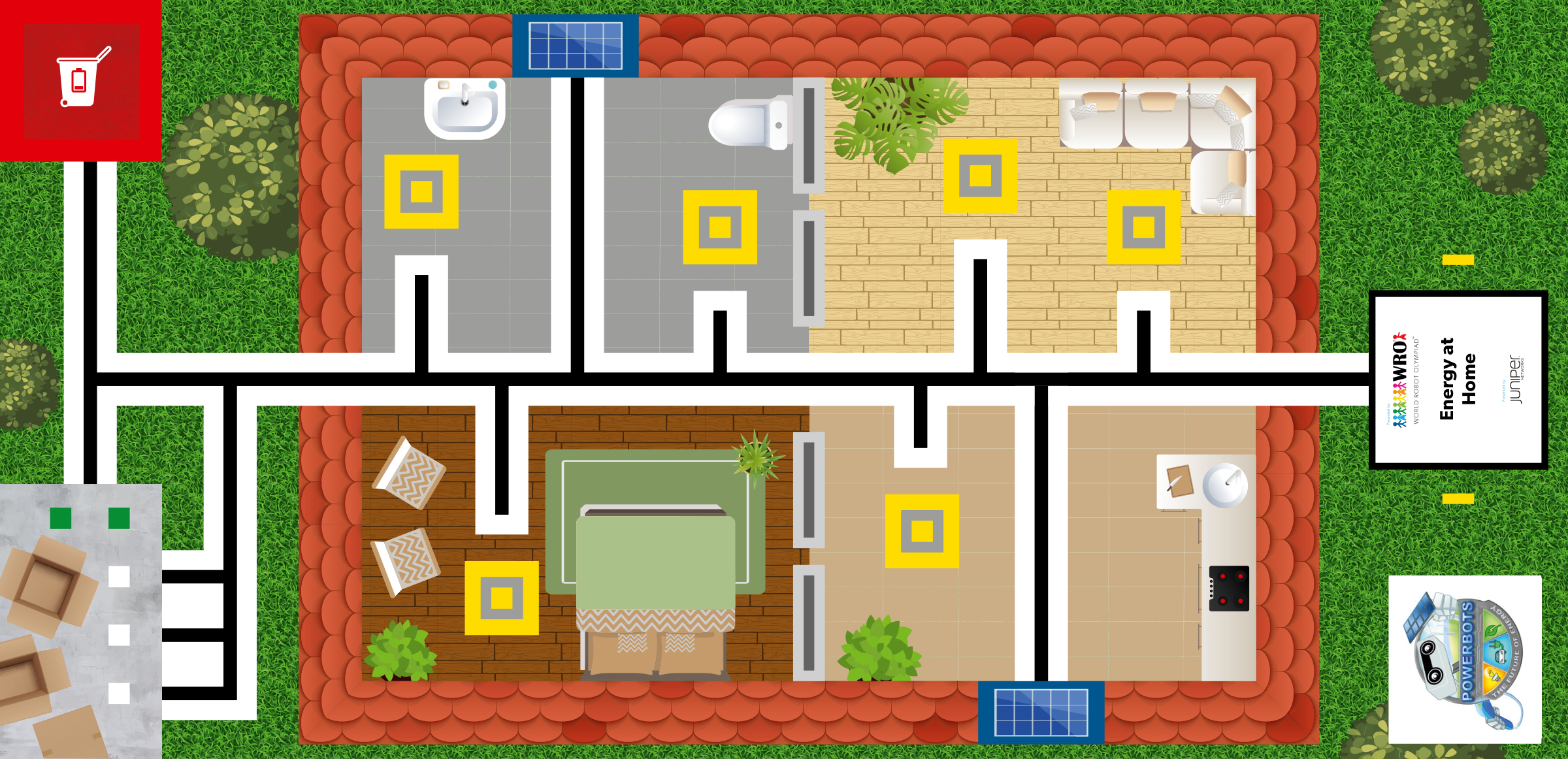
This model drives, so its challenges are run on a mat. Mats differ between branches — check you are looking at the one in your room.
WRO 2021 RoboMission Elementary — POWERBOTS — Energy at Home · official WRO game mat, 2362 × 1143 mm
The challenges name these places rather than distances, so the same challenge works on any mat:
Switch mats above and every route below is redrawn on the mat you chose.
Work through them in order — each is harder than the last. The extra challenge comes after all three, and it is meant to make you plan before you build.
Run the mission set once, untimed, and score yourself against the real rubric.
Run it again against the clock. Record the time and the score.
Make one change you believe will help, then run a third time. Record whether it actually helped.
Compete the Block 1 mock round: two scored runs, best score counts. Then write the first proper engineering journal entry — the robot design and why, the calibration numbers, the three run times, what broke and what you changed. WRO scores the journal as well as the run.