Challenge 1
List every scoring action in the garden set as its own row: what the robot must physically do, what it is worth, and what it depends on.
Quick Learn — the model, the instructions, the program and the challenges. The theory is in Full Lesson.
EV3 Robotics›Level 4 · WRO Prep›Lesson 9
Level 4 · Lesson 9 · EV3-L04-0960 minutes · Block 2 of 6 · Mat: WRO 2022 — My Robot My Friend, The Garden Robot
A new mat, a new season, and the same first question: what does this mat pay for?
Block 1 ended with a scored round on the 2021 house mat. Today you move into the garden, and you start where every competition team starts — not with bricks, but with the scoring sheet. By the end of the hour you will have a route across the 2022 mat, written down, argued over, and walked by hand.
No robot today. Nothing gets built and nothing gets programmed. This is the second time this course has asked you to keep your hands off the bricks for a whole lesson, and it is for the same reason as lesson 1: the shape of the robot is decided by the missions, so the missions have to be understood first. Block 2 raises the stakes, because this time the robot has to carry an attachment.
Open the 2022 mat in the mat picker below and find all six stations before you read on. They are not arranged in a tidy ring the way the 2021 house was:
Two things are worth noticing straight away, and both will decide your route. C and E are the same kind of place — two flower beds — so whatever your attachment does at one, it must do at the other, and they sit at opposite ends of the mat. And E is far away from everything. A route that visits E in the middle crosses the mat twice.
Here is the habit that separates teams who finish from teams who run out of time. A mission set is not a list of places to drive to. It is a list of scoring actions, and driving is the unpaid work in between.
Write the set out as a table with one row per action. For each row you need three things:
Now divide each score by a rough guess at the seconds it will cost, and rank the rows. That ranking is your route plan in disguise. The cheapest points come first, and the expensive ones are the first thing you drop when the clock beats you — which it will, in lesson 16.
Distance is not the enemy. Turning is. Teams consistently underestimate what a turn costs — every one of them is a chance to end up a few degrees off, and those degrees accumulate down the run. When you compare two routes of similar length, prefer the one with fewer turns, not the one with fewer centimetres.
Two artefacts come out of this lesson, and lesson 10 cannot start without them.
One — the route card. Draw the mat from memory, then check it against the real thing and correct it in a different colour. Mark your station order as a numbered line: HOME first, HOME last, every station you intend to score in between. Write your reason for the order beside it in one sentence.
Two — the attachment sentence. One sentence, no more, describing what the attachment has to do physically. Not “collect things” — that is not a sentence an engineer can build from. Something closer to: it has to reach forward past the wheels, close on an object about the size of a fist, hold it while the robot turns, and let go on command.
Be specific or pay for it next lesson. Lesson 10 designs a quick-swap attachment against this exact sentence. A vague sentence produces a vague attachment, and you will find out at the mock round in lesson 16 — not before.
No blocks today. Write the run as pseudocode: one line per action, in the order the robot will do them, in plain language. This is the same habit you practised in lesson 1, and it matters more now because Block 2 adds an attachment — which means some of your lines are about the arm, not the wheels.
Keep each line to one action. A good line looks like:
A line that says “go and get the thing from the tree and bring it back” is four actions pretending to be one, and it will hide the exact place your program later goes wrong.
Mark every line where the robot has to know where it is — squaring on a line, a colour check, a wall touch. Those marks are the moments your route survives or falls apart, and lessons 11 and 12 exist to make them reliable.
Take your ranking and your route card, and answer three questions as a team. Write the answers down; lesson 15 will ask for them.
Put your Block 1 base on the mat at HOME. Nobody programs it. One student pushes it by hand along the planned route while another reads the pseudocode aloud, one line at a time, and a third times the whole thing with a phone.
Stop the moment the reader says a line the pusher cannot carry out. That is a real bug, found for free, a fortnight before it would have cost you a scored run. Fix the line and start again.
Write your walk-through time down. It is optimistic — a hand is faster and cleverer than a wheel — but a route that cannot be walked inside the limit will certainly not be driven inside it.
WRO judges score the engineering journal alongside the run, and Block 2 gets its own entry. Today’s entry must contain:
Keep Block 1’s journal open beside it. The baseline times from lesson 5 and the mock-round notes from lesson 8 are the numbers Block 2 is measured against. A journal that starts fresh each block cannot show a judge that the team is improving.
This model drives, so its challenges are run on a mat. Mats differ between branches — check you are looking at the one in your room.
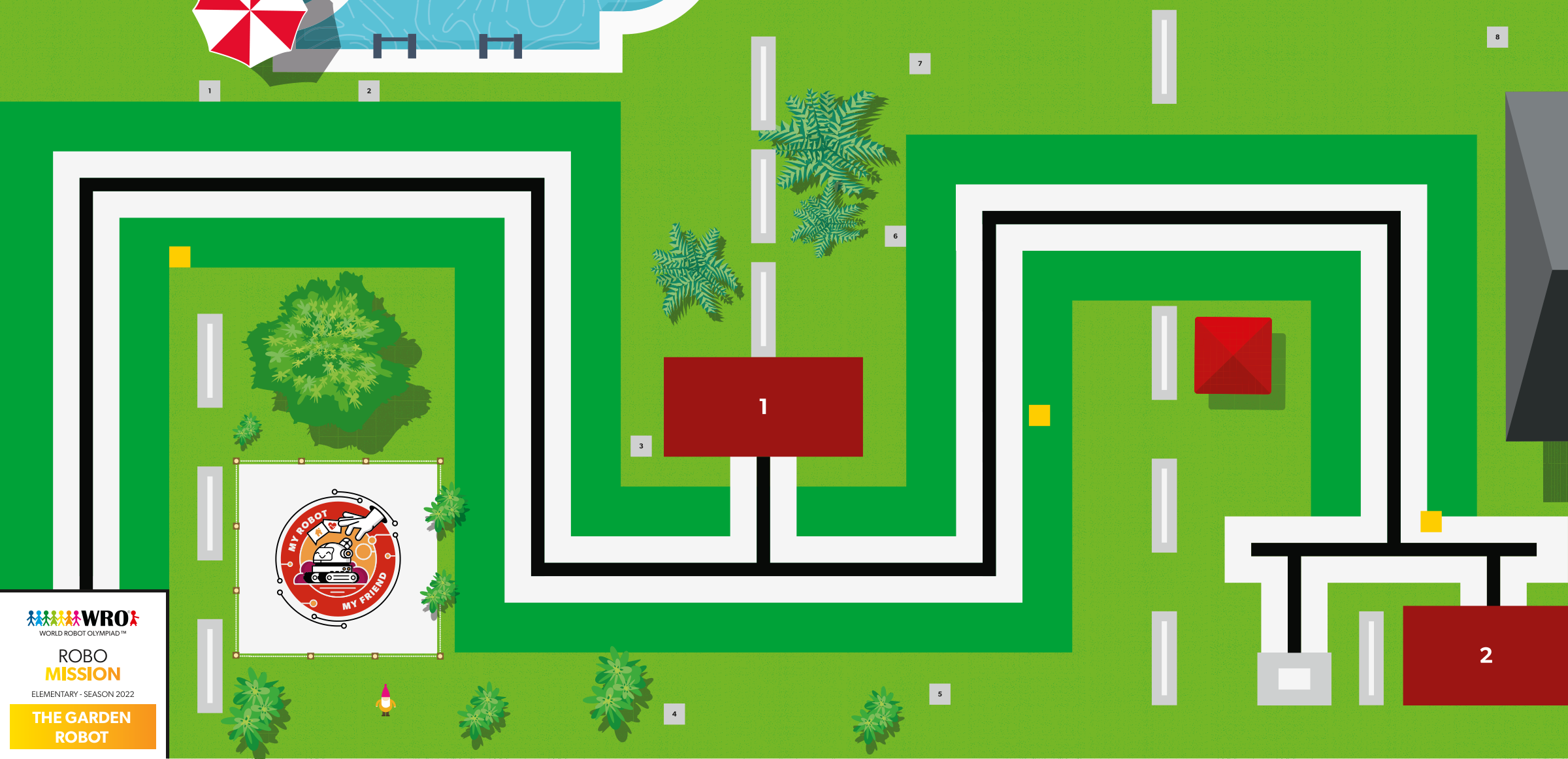
WRO 2022 RoboMission Elementary — My Robot My Friend — The Garden Robot · official WRO game mat, 2362 × 1143 mm
The challenges name these places rather than distances, so the same challenge works on any mat:
Switch mats above and every route below is redrawn on the mat you chose.
Work through them in order — each is harder than the last. The extra challenge comes after all three, and it is meant to make you plan before you build.
List every scoring action in the garden set as its own row: what the robot must physically do, what it is worth, and what it depends on.
Rank your rows by points per second, using a rough guess at the seconds each will cost. Name the two cheapest points on the mat.
Both flower beds, C and E, need the same action but sit at opposite ends of the garden. Write one sentence saying which you visit first and why.
Produce a route card for the garden set: the station order from HOME back to HOME, one sentence justifying that order, and the single sentence describing what the attachment must physically do. Then walk the route by hand and record the time.