Challenge 1
Sketch your attachment from the side and from above. Mark where it mounts to the base and which port drives it, before you pick up a brick.
Quick Learn — the model, the instructions, the program and the challenges. The theory is in Full Lesson.
EV3 Robotics›Level 4 · WRO Prep›Lesson 10
Level 4 · Lesson 10 · EV3-L04-1060 minutes · Block 2 of 6 · Mat: WRO 2022 — My Robot My Friend, The Garden Robot
Build the arm the garden needs — and make it come off and go back on in under ten seconds, without touching anything else on the robot.
Read your sentence from lesson 9 out loud before anyone opens a box. That sentence — what the attachment must physically do — is the brief. Today is the first time in Level 4 that a motor does something other than drive the robot.
Port A has been waiting for you since lesson 2. It was reserved then, along with the mounting points, precisely so that today would be a build and not a rebuild. If your base has grown into those studs, you are about to lose twenty minutes — and that is the lesson, learned the expensive way.
The attachment has to do its job at flower bed 1 at C, in the middle of the mat, and again at flower bed 2 at E, in the far bottom-right corner. Same action, opposite ends of the garden.
That matters more than it looks. If your arm only works when the robot arrives from one particular direction, it will work at one flower bed and fail at the other, and you will not find out until the route runs end to end in lesson 15. Test it today at C, and test it approaching from two different angles.
The swimming pool at A and the big tree at B are obstacles as far as this lesson is concerned. An arm that sticks out sideways will catch on things your base used to drive past cleanly.
A competition attachment is two separate problems, and teams that treat them as one problem lose time all season.
The first problem is the mechanism — the fingers, the scoop, the pusher. This is the fun part and the part everyone starts with.
The second problem is the interface — how the whole thing attaches. This is the part that decides whether you are competitive. Between rounds you may need a different attachment, and every second spent lining it up is a second not spent scoring.
Three properties make an interface good:
Why re-aligning is worse than it sounds. Your follower is tuned to where the Colour Sensor sits. Shift that sensor by half a centimetre and the same program follows the line differently. A team that re-aligns the robot to fit the attachment has quietly thrown away lesson 12’s tuning without noticing.
Sketch first, from the side and from above, and mark three things: where it mounts, which way it moves, and where the motor sits. Then build.
Drive it from port A. Keep the motor on the robot, not on the removable part, if you possibly can — a motor on the attachment means unplugging a cable in every swap, and cables are slow and easy to get wrong under pressure.
Build the mechanism so that its resting position is safe. An arm that hangs down at the start will catch the mat as the robot sets off, and the first you know about it is a run that fails before it reaches the first station.
The attachment needs exactly two programs today, and both are short. One closes or lifts. One opens or lowers. Nothing else.
Use Move Motor for Degrees on port A, not a timed move. Degrees repeat; seconds do not, because a motor pushing against something takes longer to travel the same distance than a motor moving freely.
Find the two numbers by hand: turn the motor until the mechanism is where you want it, read the degrees off the port view, and write both numbers in the journal. Those two numbers are the attachment’s entire interface to the rest of your programs, and lesson 13 turns them into a My Block.
Stall the motor on purpose, once. Run the closing move with something too big in the way and listen to it strain. Now you know what a jammed attachment sounds like, which is worth knowing before it happens in a scored round.
Put the robot on the table. Start a timer. Take the attachment off, put it back on, and stop the timer. Write the number down.
Now make it faster, and change only one thing at a time so you know what worked. Fewer pins. A pin you can reach without turning the robot over. A lip that drops into place so you are not aiming while you fasten. Re-time after each change.
When the swap is quick, check the thing that actually matters: put the attachment on and off three times, and after each one confirm the Colour Sensor still reads the same value over the same patch of mat. If that number moves, the interface is not doing its job yet, however fast it is.
Drive from HOME to the flower bed at C, act on the object with the attachment, turn a full circle with the object held, and come back to HOME. Do it twice.
The turn is not decoration. It is the test — an attachment that grips well enough standing still and drops its load in a turn is an attachment that will fail on the leg between C and E.
Today’s entry:
This model drives, so its challenges are run on a mat. Mats differ between branches — check you are looking at the one in your room.
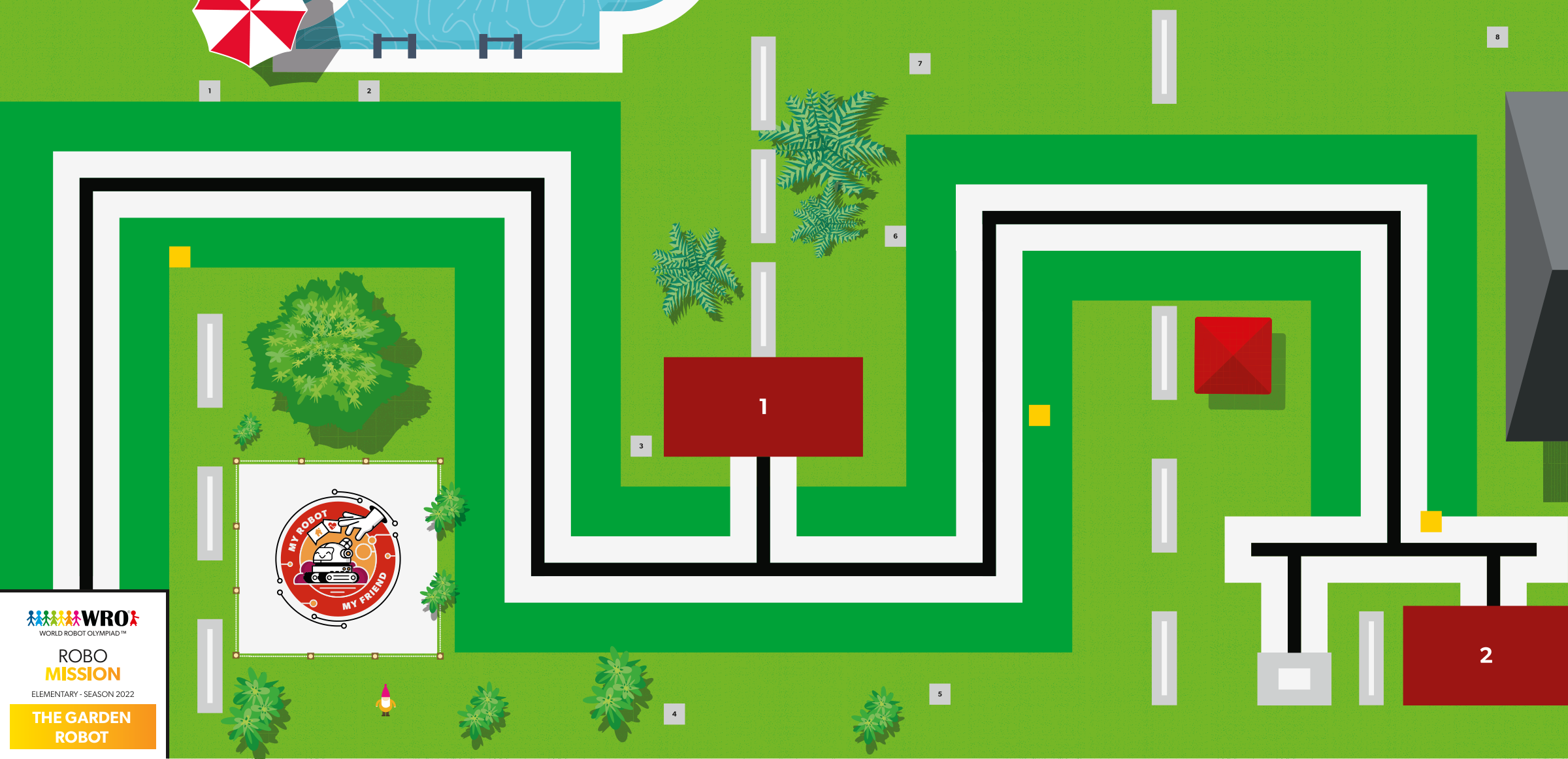
WRO 2022 RoboMission Elementary — My Robot My Friend — The Garden Robot · official WRO game mat, 2362 × 1143 mm
The challenges name these places rather than distances, so the same challenge works on any mat:
Switch mats above and every route below is redrawn on the mat you chose.
Work through them in order — each is harder than the last. The extra challenge comes after all three, and it is meant to make you plan before you build.
Sketch your attachment from the side and from above. Mark where it mounts to the base and which port drives it, before you pick up a brick.
Time a swap. Take the attachment off and put it back on, and write down the seconds. Then change the mount so it is faster, and time it again.
Hold the robot up and shake it gently. If the attachment shifts against the frame, brace it and repeat until it does not.
Build the attachment and prove it against the sentence you wrote in lesson 9. It must reach past the wheels, act on an object at the flower bed at C, hold it through a turn, and release on command — then come off and go back on in under ten seconds.