Challenge 1
Select the blocks of your proportional follower and turn them into a My Block called Follow Line.
Quick Learn — the model, the instructions, the program and the challenges. The theory is in Full Lesson.
EV3 Robotics›Level 4 · WRO Prep›Lesson 13
Level 4 · Lesson 13 · EV3-L04-1360 minutes · Block 2 of 6 · Mat: WRO 2022 — My Robot My Friend, The Garden Robot
Make your program readable by somebody who has never seen it — without changing a single thing the robot does.
Your follower works. Your attachment works. And your program is already a wall of blocks that only makes sense to whoever typed it, on the day they typed it. Today you give the manoeuvres names.
Nothing will look different when you run it. Same route, same speed, same times. If a teammate says “but it does exactly what it did before”, the answer is yes — that is how you know you did it right. The gain is not on the mat, it is on the screen.
Stay on HOME to flower bed 1 at C — the same leg you raced last lesson. Reusing it is deliberate: you already know exactly how it should behave and how long it should take, so if the rebuilt version drifts you will notice immediately.
Have lesson 12’s winning time in front of you. The rebuilt program should match it. If it does not, something moved during the rebuild.
A My Block takes a group of blocks and hides them behind a name. That is the whole mechanic. The skill is choosing which blocks to group and what to call the result.
Group blocks that together do one thing a person would say in one breath. “Follow the line until the station.” “Square up.” “Collect.” Those are manoeuvres. A group of blocks that needs the word and to describe it is two My Blocks wearing a coat.
The name matters as much as the grouping, because the name is what the rest of the team reads at midnight before a competition. Names that work describe the intention:
The test for a good name. Show the main canvas to somebody from another team and ask them what the robot does. If they can tell you without opening anything, the names are right. If they have to open a block to find out, the name is a label, not a name.
There is a second prize, and it arrives at the worst moment. When the follower needs a tweak an hour before a round, you change it once, inside Follow Line, and every leg of every mission gets the fix. Teams without My Blocks are hunting through copies and always miss one.
Before touching the software, write the list of manoeuvres your garden run is made of. One line each, plain language, in order.
Most teams find three or four: get down a line, stop square on a station, work the attachment, turn to face the next leg. If your list is longer than six, some entries are steps rather than manoeuvres — merge them.
Beside each one, write the numbers it needs. Follow Line needs a gain and a speed. Collect needs the two motor numbers from lesson 10. Today those numbers live inside the blocks; tomorrow lesson 14 pulls them out as inputs, and this list is what makes that painless.
Work one manoeuvre at a time, and run the program after each one. Building three My Blocks and then testing is how a team spends the back half of the lesson looking for which of three changes broke it.
Follow Line first. Select the loop and everything inside it, make it a My Block, name it, and run the leg. Time should match lesson 12.
Then Square Up, from your Block 1 squaring routine.
Then Collect, wrapping the two attachment moves from lesson 10.
Now look at the main canvas. It should read as three or four named blocks in a row and nothing else. Any raw motor block still sitting there belongs inside one of them — or is a manoeuvre you have not named yet.
Swap seats with another team and read each other’s main canvas without opening anything. Write down what you think their robot does.
Compare notes. Every place the reader guessed wrong is a naming problem, and it is free to fix now and expensive to fix in a competition week.
Rename your worst-named block, and write one sentence on what was wrong with the old name. “It described how it worked instead of what it was for” is the most common answer, and a good one.
Run HOME to C with the rebuilt program, twice. It should behave exactly as it did in lesson 12 and take the same time.
Then prove the second prize. Change the gain once, inside Follow Line, and run again. One edit, and every use of the follower changed with it — that is what you have actually bought today.
Today’s entry:
Judges read this section closely. WRO scores the journal, and a team that can show a program becoming readable — and explain why that mattered when something broke — is showing engineering judgement, not just a working robot.
This model drives, so its challenges are run on a mat. Mats differ between branches — check you are looking at the one in your room.
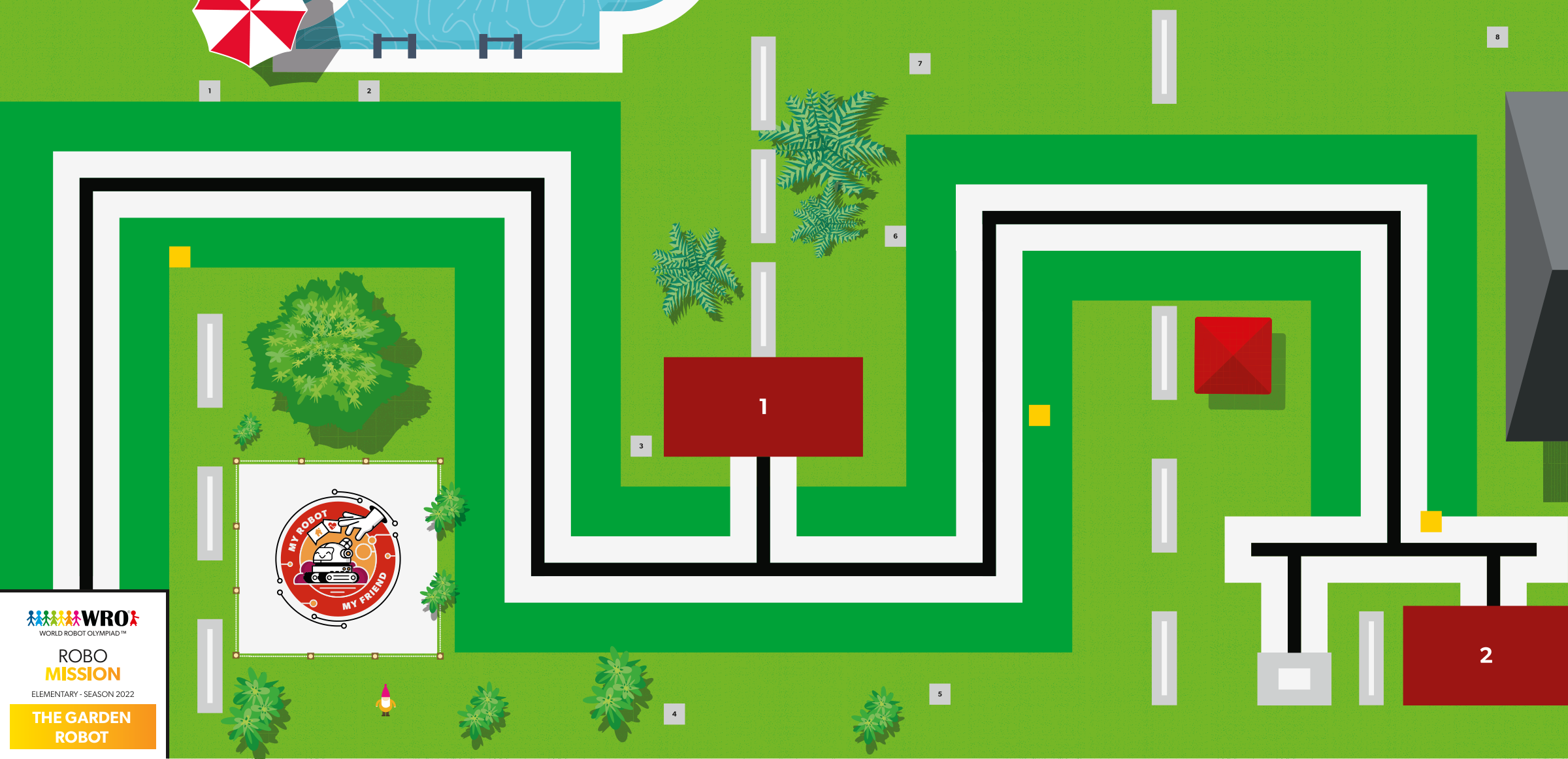
WRO 2022 RoboMission Elementary — My Robot My Friend — The Garden Robot · official WRO game mat, 2362 × 1143 mm
The challenges name these places rather than distances, so the same challenge works on any mat:
Switch mats above and every route below is redrawn on the mat you chose.
Work through them in order — each is harder than the last. The extra challenge comes after all three, and it is meant to make you plan before you build.
Select the blocks of your proportional follower and turn them into a My Block called Follow Line.
Rebuild the HOME to C leg using nothing but that block and a stop condition, and confirm it runs the same as it did before.
Rename one of your My Blocks to something a stranger could understand without asking you. Say in one sentence what was wrong with the old name.
Rewrite your lesson 12 program so the main canvas reads as a list of intentions — Follow Line, Square Up, Collect — with no raw motor blocks left on it at all.