Challenge 1
Take the three garden missions you ranked highest in lesson 9 and write the station order for all three as a single route.
Quick Learn — the model, the instructions, the program and the challenges. The theory is in Full Lesson.
EV3 Robotics›Level 4 · WRO Prep›Lesson 15
Level 4 · Lesson 15 · EV3-L04-1560 minutes · Block 2 of 6 · Mat: WRO 2022 — My Robot My Friend, The Garden Robot
Three garden missions. One program. One green button, and no hands on the robot until it comes home.
Nothing in today’s lesson is new. The follower is lesson 12’s, the attachment is lesson 10’s, the blocks are lessons 13 and 14’s. The only new thing is that they all have to work in a row, and that turns out to be the hard part.
One rule, strictly. No raw motor blocks on the main canvas. Everything is a My Block. If you find yourself reaching for a bare motor block to patch a gap, you have found a manoeuvre you have not named yet — name it and put it in a block.
Take the three missions you ranked highest back in lesson 9. For most teams that means a route out from HOME through the big tree at B and flower bed 1 at C, on to the red patch at D, and back to HOME.
Leave flower bed 2 at E out today. It is the far corner, it doubles the route length, and today is about making three missions hold together — not four. E arrives in the mock round next lesson, which is the right place to find out what it costs.
Write the station order down and put it beside the keyboard. Every My Block call on your canvas should map to a line of it.
Here is the thing that catches every team the first time they join missions up. Tested one at a time, each leg starts from a robot you placed by hand — square, straight, in the right spot. In a real run, each leg starts wherever the previous leg left the robot.
So errors add up. Two degrees off leaving B is barely visible. Add the two degrees from the turn, and the drift down the leg to C, and by the time the robot reaches D it is far enough out that the attachment closes on nothing at all.
There are two honest answers, and you want both:
The diagnostic that saves the afternoon. If the run fails at the third mission, do not start editing the third mission. Run just the first two and look at where the robot is sitting when they end. Nine times out of ten the third mission is fine and it was handed a robot in the wrong place.
No robot building. Instead, solve the problem that ruins otherwise good runs: placing the robot at HOME the same way every time.
If you start the robot a centimetre further left than you did in testing, the whole run inherits that centimetre. Competitions expect you to place it by hand, so decide now exactly how: which edges of the base pad the wheels touch, which way the robot faces, and what you line up against.
Write it down as a placement rule anyone on the team can follow without asking, and use it for every run from now on. Teams that skip this spend the mock round debugging a program that was never broken.
Build the canvas as a list of calls that reads like the route card. One line per action, in order, and nothing on the canvas that is not a My Block.
Then dry-run it by hand before you power up. Push the robot along the route while somebody reads the canvas aloud, one call at a time — the same walk-through as lesson 9, now against a real program. Every mismatch you find here is one you did not spend a battery discovering.
When you do run it, run it whole. Stopping the robot to fix something mid-run tells you nothing about whether the missions survive each other, which is the entire question today.
Run it, and mark the first line where it goes wrong. Not the first place it looks wrong — the first place it is wrong. Those are different, and the gap between them is where the afternoon goes.
Fix that one line. Run again. Mark the new first failure. Repeat.
Resist changing three numbers between runs. It feels faster and it is not: when the run improves you will not know which change did it, and when it gets worse you will not know which to undo.
The milestone is two clean runs in a row, without a reset, placing the robot by your own placement rule each time.
Twice matters. One clean run can be luck — a drift that happened to cancel out. Two in a row means the program is repeatable, which is the only property a competition actually rewards.
Time both. Next lesson is scored against the clock, and you want to know now whether three missions already fill the round.
Today’s entry:
This model drives, so its challenges are run on a mat. Mats differ between branches — check you are looking at the one in your room.
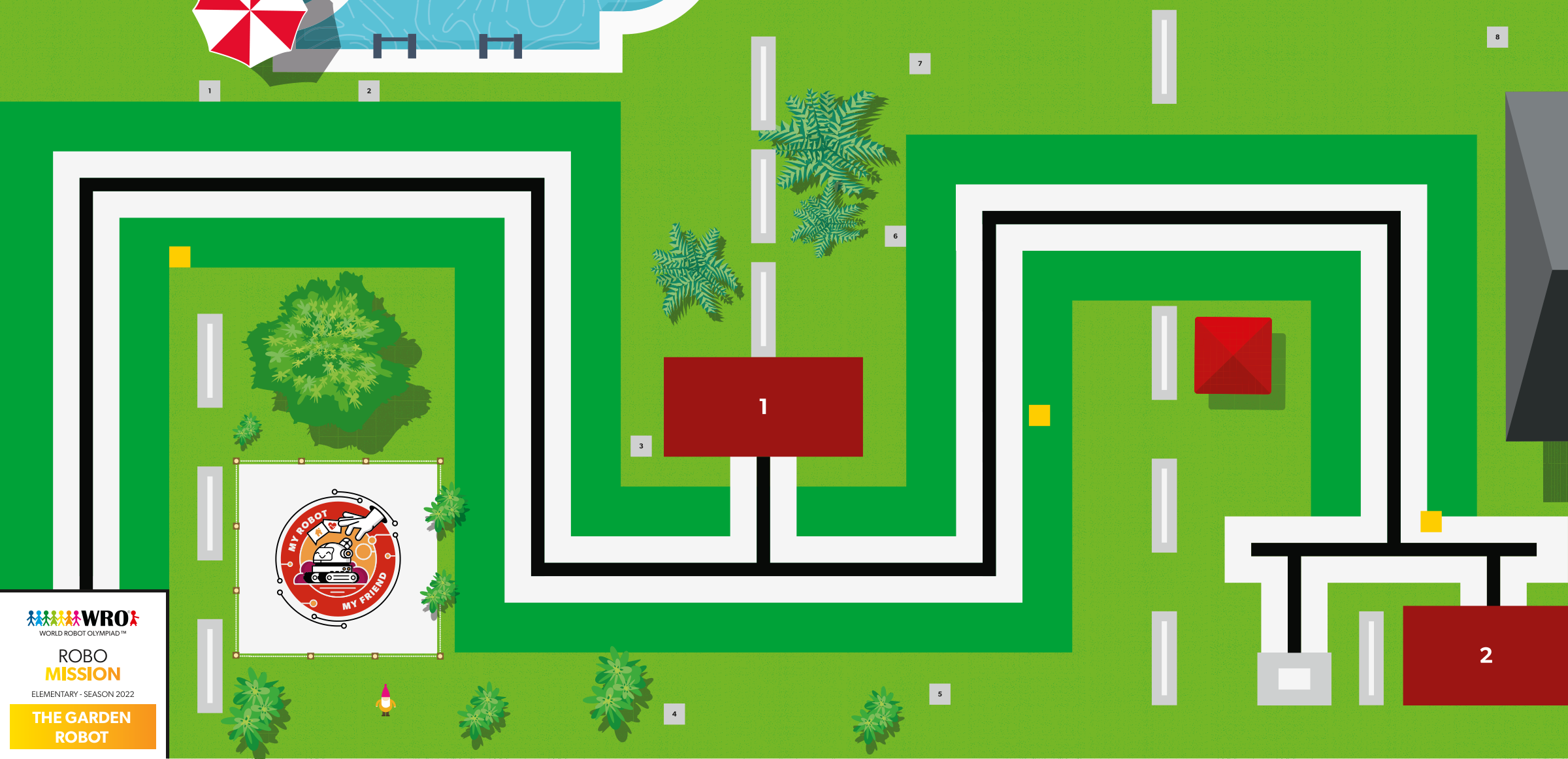
WRO 2022 RoboMission Elementary — My Robot My Friend — The Garden Robot · official WRO game mat, 2362 × 1143 mm
The challenges name these places rather than distances, so the same challenge works on any mat:
Switch mats above and every route below is redrawn on the mat you chose.
Work through them in order — each is harder than the last. The extra challenge comes after all three, and it is meant to make you plan before you build.
Take the three garden missions you ranked highest in lesson 9 and write the station order for all three as a single route.
Build the program from My Blocks only, one call per line, and dry-run it by hand on the mat before you power up.
Run it and mark the first line where it goes wrong. Fix that line only, then run it again.
String three garden missions together in one program built entirely from My Blocks, starting and finishing at HOME, and complete it twice in a row without a reset.