Challenge 1
Set the mat up to competition standard and run your program once, cold, with no practice run first. Record the score.
Quick Learn — the model, the instructions, the program and the challenges. The theory is in Full Lesson.
EV3 Robotics›Level 4 · WRO Prep›Lesson 16
Level 4 · Lesson 16 · EV3-L04-1660 minutes · Block 2 of 6 · Mat: WRO 2022 — My Robot My Friend, The Garden Robot
Competition conditions. The garden set, against the clock, scored — and this time flower bed 2 at E is on the table.
Everything you need already exists. Today is not for building or for learning a technique; it is for finding out what your block of eight lessons is actually worth when nobody is allowed to help.
No coaching during a round. Once the round starts, the team may not touch the robot or the computer. Everything a teacher would normally say has to have been said beforehand — which is exactly the point of running a mock.
Lesson 15 ran HOME to B to C to D and home again. Today the far corner is available: flower bed 2 at E, bottom right, the most remote station on the mat.
Nobody is telling you to include it. That is the decision, and it is a real one — E is worth points, and getting there and back may cost more seconds than those points are worth. You argued about this in lesson 9 without evidence. Now you have times.
Decide before the first round, write the decision down with the reason, and hold to it. Changing your mind mid-round is how teams end up with half a route.
Competition scoring is not a test of your best-ever run. It rewards the run you can produce on demand, cold, once — and those are different things.
Three costs are worth naming before you start, because each is measurable today:
Points per second decides everything. The same ranking you built on paper in lesson 9 is now settled by measurement rather than argument. A mission that scores well but eats a third of the round may be the right thing to drop — and being able to say so with numbers is what a judge is looking for.
No robot work. Set the room up like a competition instead, because the conditions are half of what you are testing.
The program should already be finished. Today’s programming work is to stop changing it and make it easy to run under pressure.
Check the main canvas one last time against the rule from lesson 15: My Blocks only, one call per action, reading in route order. If a teammate cannot find the line that runs a given mission within a few seconds, rename something now rather than in the round.
Make sure the right program is the one that starts when the button is pressed. Teams lose whole rounds to running yesterday’s version, and it is entirely avoidable.
Between rounds you get two minutes. That is enough to change one thing and nothing more.
Decide what that change will be before the round ends, while you are watching it fail. Then make it, run again, and record whether the score moved.
This constraint is not artificial. It is the real one, and teams that practise working inside it stop making the classic mistake of rewriting three things in a panic and arriving at the next round with a program nobody has ever seen run.
Round one is cold. No practice run, no warm-up lap, no last adjustment. Place the robot by your placement rule, start it, and let it go. Score it.
Two minutes. One change. Round two. Score it.
Then, separately from the scoring, time an attachment swap against the clock so you know what it would cost you if a future mat needed two of them.
The last lesson of a block collects the whole block. Today’s entry has to stand on its own for a judge:
These numbers are used again. Block 3 takes the gyro to the accumulated-error problem you met in lesson 15, and lesson 30 in Block 4 puts basic, proportional and PID side by side over the same leg. Both of those comparisons start from what you write down today.
This model drives, so its challenges are run on a mat. Mats differ between branches — check you are looking at the one in your room.
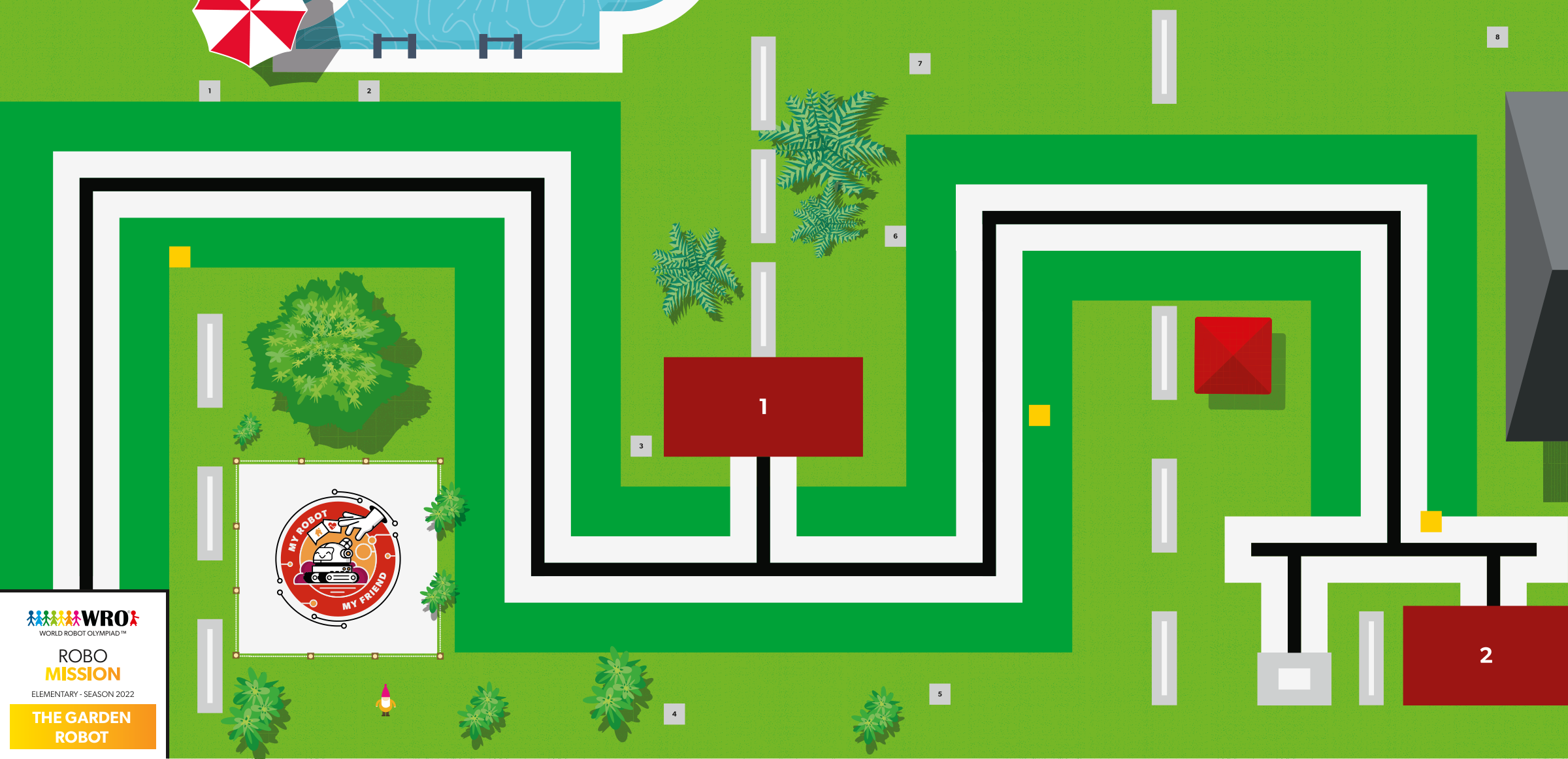
WRO 2022 RoboMission Elementary — My Robot My Friend — The Garden Robot · official WRO game mat, 2362 × 1143 mm
The challenges name these places rather than distances, so the same challenge works on any mat:
Switch mats above and every route below is redrawn on the mat you chose.
Work through them in order — each is harder than the last. The extra challenge comes after all three, and it is meant to make you plan before you build.
Set the mat up to competition standard and run your program once, cold, with no practice run first. Record the score.
You get two minutes between rounds. Change exactly one thing, run again, and record whether the score moved.
Swap the attachment mid-round against the clock, and record what the swap cost you in seconds.
Score the 2022 garden set in a timed round, then journal what the attachment and the proportional follower each cost you in seconds, measured against Block 1's baseline times.