Challenge 1
List every scoring action on the marine set as its own row: what the robot must physically do, what it is worth, and what it depends on.
Quick Learn — the model, the instructions, the program and the challenges. The theory is in Full Lesson.
EV3 Robotics›Level 4 · WRO Prep›Lesson 17
Level 4 · Lesson 17 · EV3-L04-1760 minutes · Block 3 of 6 · Mat: WRO 2023 — Connecting the World, Marine Life Preservation
A new mat, and for the first time a plan you can cost in seconds instead of guessing at.
In lesson 9 you ranked missions by points per second using rough estimates, because estimates were all you had. Block 2 changed that. You now know what a leg costs, what the attachment costs, and what a round feels like when the clock is real. Today you plan with those numbers.
No robot today. Third time, same reason, and by now it should feel normal: the missions decide the robot. Have Block 2’s journal open — the mock-round times from lesson 16 are the raw material for everything you do this hour.
Seven places this time, one more than the garden. Find them all before reading on:
Look at A, B, C and D together. Four reefs in a square — the same kind of station, four times over. Whatever your robot does at one reef, it will do at all four, and only the numbers change.
That is a gift, and it is the reason this block can spend four lessons on the gyro. You already built parameterised My Blocks in lesson 14; a grid of identical stations is precisely the shape those blocks were made for.
Write the round length at the top of a page. That is your whole budget, and every second you spend has to come out of it.
Now spend it, using numbers you actually measured in Block 2:
Add it up for the route you want to run — HOME, all four reefs, the lighthouse, the octopus, back to HOME. It will not fit. That is not a failure of arithmetic, it is the actual competition problem, and finding it on paper costs you nothing.
Now the real skill: decide what not to do. Cut until the budget balances, and cut by points per second — cheapest points stay, expensive ones go. A team that scores four missions cleanly beats a team that attempts seven and finishes two.
One caution on the reefs. Because they are identical, it is tempting to treat them as one cheap block of four. Check the travel between them before you assume that: four stations in a square still means three legs and three turns, and the corners are where a route quietly gets expensive.
Two artefacts again, and lesson 18 needs the second one.
One — the costed route card. Your station order from HOME back to HOME, with a time written beside every leg and every action, and a total at the bottom that fits inside the round. Mark the missions you cut and what they were worth, because a judge will ask.
Two — the sorter sentence. One sentence describing what the attachment must physically do on this mat. This mat asks for more than the garden did: the items have to be collected and told apart, and carried through turns without being dropped or muddled. Say what “told apart” means for your design — by colour, by where they are put, or by when they are collected.
Pseudocode again, one line per action. But this time write it in the names of the My Blocks you already have — Follow Line, Turn By Degrees, Collect — rather than in loose English.
Two things fall out of that immediately. Most of the route is already written, because Block 2 built the vocabulary. And the gaps stand out: the places where you need a manoeuvre that does not exist yet.
Mark every gap. Look at where they cluster — for most teams it is the turns between reefs and the long open crossings where there is no line to follow. Those gaps are what Block 3 is about, and lessons 19 to 22 fill them.
Three questions, answered as a team and written down:
That last one is what separates a plan from a wish. Deciding in advance which mission you sacrifice means you can drop it calmly instead of watching the clock run out mid-route.
Your Block 2 robot goes on the mat at HOME. Nobody programs it. One student pushes it along the planned route, another reads the pseudocode aloud, a third times it.
Compare the walked time against your budget. A walked route is optimistic — a hand turns instantly and never drifts — so if the walk-through is already close to the limit, the driven version will not fit and the plan needs cutting again, today.
Today’s entry opens Block 3:
This model drives, so its challenges are run on a mat. Mats differ between branches — check you are looking at the one in your room.
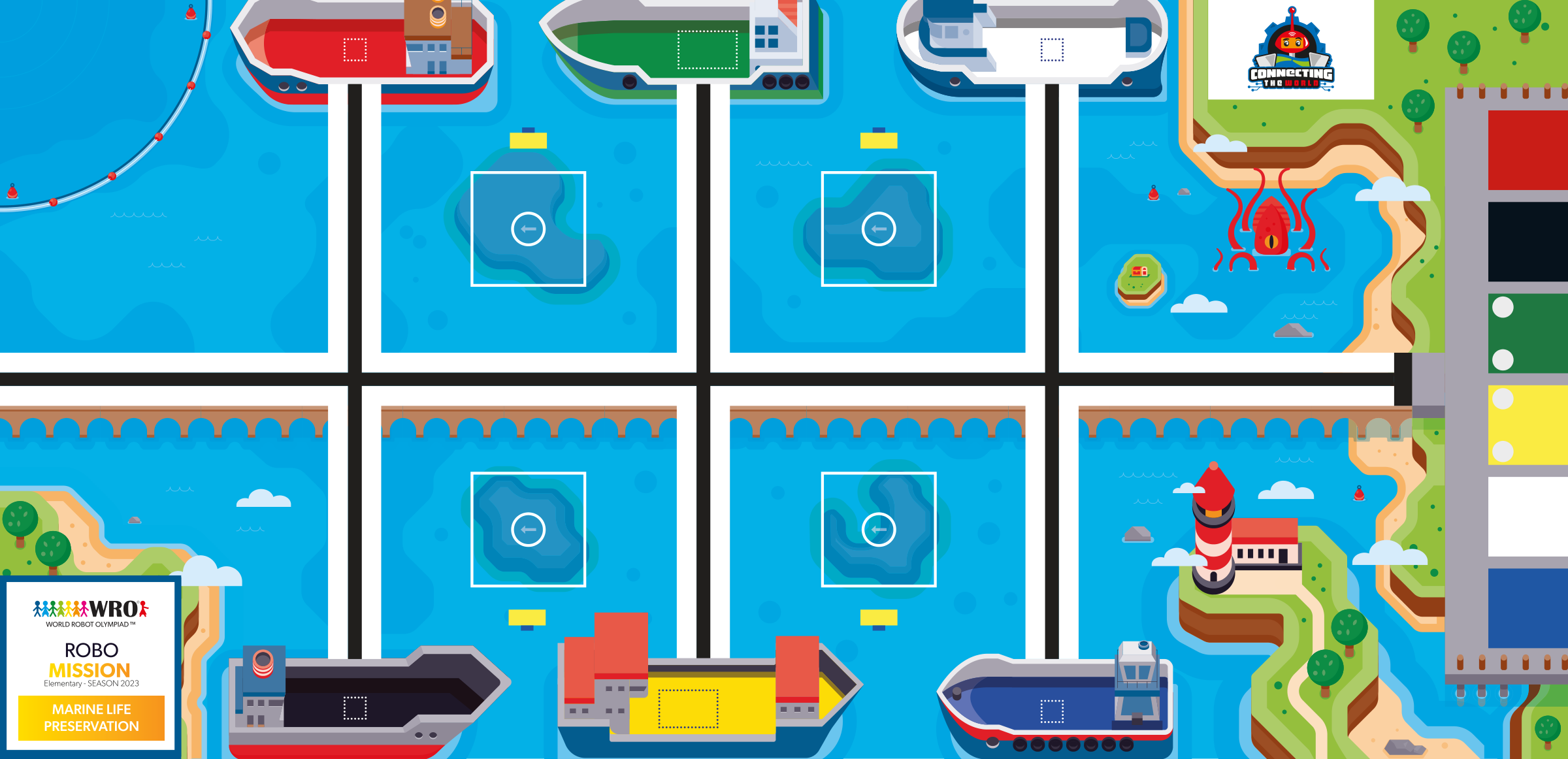
WRO 2023 RoboMission Elementary — Connecting the World — Marine Life Preservation · official WRO game mat, 2362 × 1143 mm
The challenges name these places rather than distances, so the same challenge works on any mat:
Switch mats above and every route below is redrawn on the mat you chose.
Work through them in order — each is harder than the last. The extra challenge comes after all three, and it is meant to make you plan before you build.
List every scoring action on the marine set as its own row: what the robot must physically do, what it is worth, and what it depends on.
Cost the route you want to run in seconds, using the times you measured in Block 2 — setup, each leg, each station action — and total it against the round length.
It will not fit. Cut missions by points per second until the budget balances, and write down what you dropped and what it was worth.
Produce a costed route card for the marine set: the station order from HOME back to HOME, a time beside every leg and every action, a total that fits inside the round, and the one sentence saying what the sorter must physically do. Then walk it by hand and compare the walked time against your budget.