Challenge 1
List every leg of your route and note two things for each: is there a line, and what must be true about the robot when it arrives.
Quick Learn — the model, the instructions, the program and the challenges. The theory is in Full Lesson.
EV3 Robotics›Level 4 · WRO Prep›Lesson 22
Level 4 · Lesson 22 · EV3-L04-2260 minutes · Block 3 of 6 · Mat: WRO 2023 — Connecting the World, Marine Life Preservation
You own two ways to cross a mat. Today you decide, leg by leg, which one each part of your route gets — and write down why.
Nothing is built today and no new block is introduced. This is a planning lesson, and it is the one that turns a collection of techniques into a strategy.
The gyro is not an upgrade. It is newer, so it feels like the better tool, and teams that have just learned it try to use it for everything. On a leg with a good line, the follower is usually the right answer — and being able to explain that is worth more marks than a robot that gyros everywhere.
Take the costed route card from lesson 17 and list its legs one per line, in order. For most teams that is something like: HOME out to the first reef, reef to reef around the square, then the long crossing back to the harbour dock, possibly by way of the lighthouse island at E.
Beside each leg, note two facts and nothing else yet: is there a line? and what does the robot need to be true when it arrives?
That second question is the one teams skip. Arriving at a reef to collect needs the robot in the right place. Setting off across open water needs it pointing the right way. Those are different requirements and they want different tools.
Here is the sentence the whole lesson rests on, and it is worth writing on the board.
A line follower corrects position. Heading hold corrects rotation.
A follower keeps the robot on the line, and it does not care which way the robot is pointing as long as the sensor is over the edge. It actively pulls the robot back to a known place on the mat. If the robot starts a lined leg slightly off, the line removes that error.
Heading hold keeps the robot pointing the right way, and it does not know where it is. Knock it sideways and it will keep its heading perfectly while travelling down a parallel path a few centimetres off the one you wanted. It preserves the error it started with.
That is why lines win where they exist. Across a route, position errors accumulate — every leg starts where the last one finished, which you felt in lesson 15. A line resets that debt. A heading does not.
So the decision comes down to a short set of questions per leg:
One more, easy to miss: how long is the leg in seconds? Gyro drift grows with time, as you measured in lesson 19. A long slow heading-held leg accumulates drift that a short one does not.
Turn your list of legs into a table with four columns: the leg, the tool you have chosen, the reason in one short phrase, and what the robot must be true on arrival.
Every row must have a reason. “Because it works” is not one. “No line out there” is. “Ends at a reef where position matters” is. “Short leg, drift won’t matter” is.
This table is a journal artefact and a judging one. A team that can hand over a routing table with defensible reasons is demonstrating engineering judgement, which is scored, rather than a lucky robot, which is not.
No new blocks. Write the route as calls to blocks you already have: Follow Line, Move Straight, Turn By Degrees, Square Up, Collect.
Your routing table is now literally the program. Each row becomes one call, and the tool column decides whether that call is Follow Line or Move Straight.
Pay attention to the handovers between the two. When a lined leg hands over to a heading-held one, the robot must zero the gyro at the moment of handover so the new heading is measured from where the line left it, not from wherever the last reset happened.
Getting that wrong produces a leg that sets off at a confidently wrong angle, and it is the single most common bug when a team first mixes the two.
Find the leg your team disagreed most about and test both options on it. Three runs each, and measure what actually matters for that leg — where the robot ends up, or which way it is facing, or both.
Keep the numbers even for the option you reject. A routing table backed by six measurements is a different document from one backed by opinion, and it is exactly the kind of thing that separates teams in judging.
Then swap tables with another team and challenge one row each. If they cannot defend it, they have found a row worth re-testing.
Run a lined leg into a reef, then the open crossing back towards the harbour dock at HOME, as one program with the handover in the middle.
Watch the join. The robot should finish the lined leg where the line put it, take its new heading from there, and hold it across the open water. If it lurches at the handover, the gyro was zeroed at the wrong moment.
Today’s entry:
Lesson 23 runs this table. The milestone next hour is a four-leg route where every turn is a gyro turn and every straight is heading-held — so any row you cannot defend today becomes a failure you get to debug tomorrow.
This model drives, so its challenges are run on a mat. Mats differ between branches — check you are looking at the one in your room.
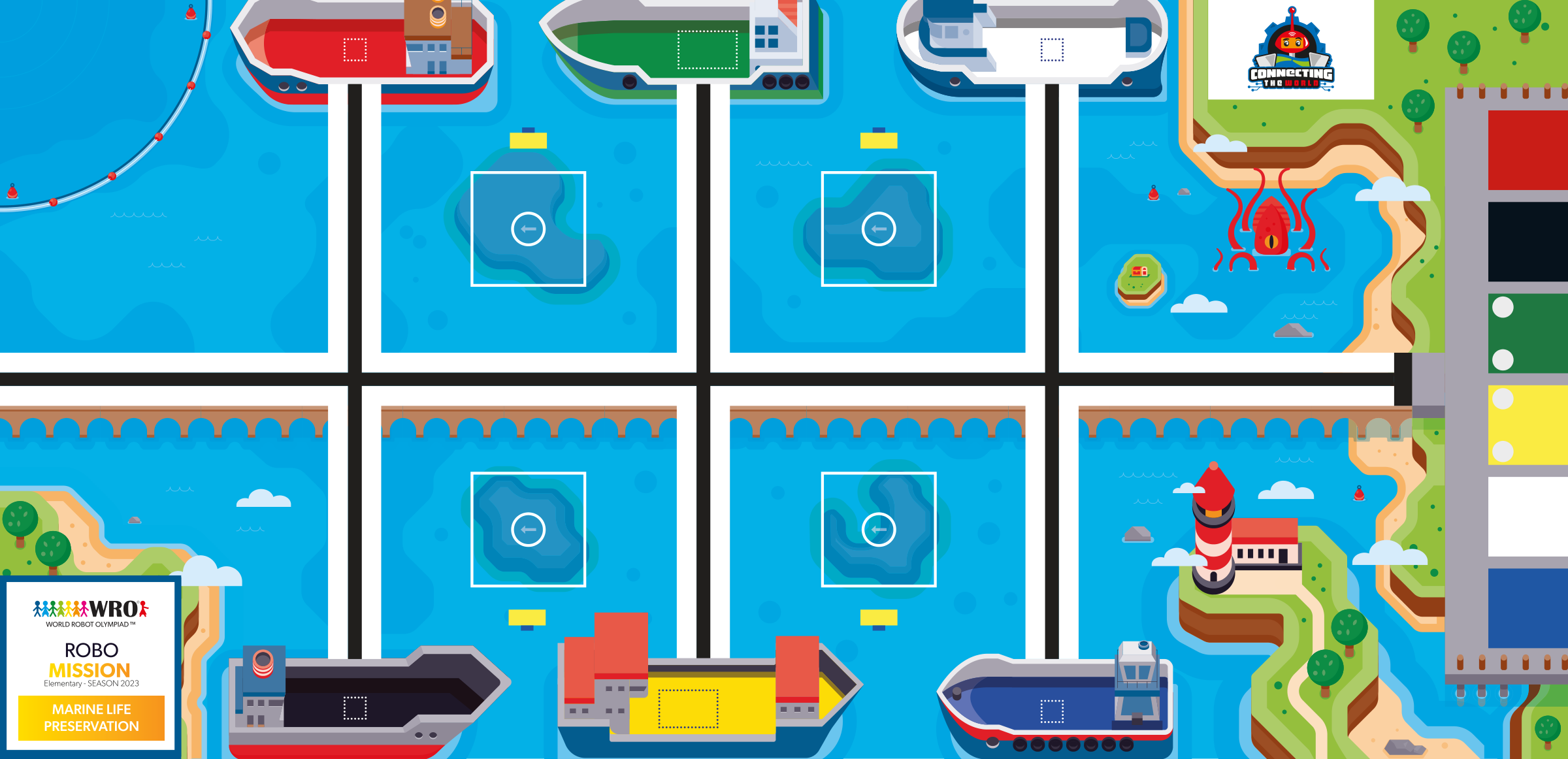
WRO 2023 RoboMission Elementary — Connecting the World — Marine Life Preservation · official WRO game mat, 2362 × 1143 mm
The challenges name these places rather than distances, so the same challenge works on any mat:
Switch mats above and every route below is redrawn on the mat you chose.
Work through them in order — each is harder than the last. The extra challenge comes after all three, and it is meant to make you plan before you build.
List every leg of your route and note two things for each: is there a line, and what must be true about the robot when it arrives.
Turn that list into a routing table — leg, tool, reason, arrival requirement — with a real reason on every row. 'Because it works' is not one.
Take the leg your team disagreed about most and test both tools on it, three runs each, measuring what actually matters for that leg.
Run a lined leg into a reef and the open crossing back to HOME as one program, zeroing the gyro at the handover between them. Then defend one row of your routing table to another team.