Challenge 1
Write your four legs as a routing table and mark the points where the robot genuinely knows its heading. Those are your re-zero points.
Quick Learn — the model, the instructions, the program and the challenges. The theory is in Full Lesson.
EV3 Robotics›Level 4 · WRO Prep›Lesson 23
Level 4 · Lesson 23 · EV3-L04-2360 minutes · Block 3 of 6 · Mat: WRO 2023 — Connecting the World, Marine Life Preservation
Four legs, one program. Every turn a gyro turn, every straight heading-held — and the robot still arrives where it should at the end.
Nothing new today. The gyro is lesson 19’s, the turns are lesson 20’s, the straights are lesson 21’s, and the plan is lesson 22’s routing table. The only new thing is that all of it has to hold together for four legs in a row.
The bar is strict on purpose. No timed motor moves patching a leg that will not behave. If one leg keeps failing, fix it with the tools from this block — a patch works today and fails next lesson under competition conditions, which is a worse place to find out.
Four legs from your routing table. For most teams that means out from HOME at the harbour dock to a reef, around two or three sides of the reef square, and the long open crossing back to the dock.
The reef square is where the turns live — A to B across the north, B to D down the east, D to C along the south. The crossing home is where the heading hold earns its keep.
Leave the octopus at F out today unless your lesson 17 budget already included it. Four legs is the milestone; adding a fifth to prove a point means debugging five when four are not yet reliable.
Two things you already know now meet, and the meeting is the whole lesson.
From lesson 15: every leg starts where the last one finished, so position errors accumulate down a route.
From lesson 19: gyro drift grows with time, so the heading you are holding on leg four is measured from a zero you set minutes ago.
Put those together and a four-leg route has two separate debts growing at once. The robot can be pointing a little wrong and be a little to one side, and neither error announces itself until the attachment closes on empty water.
The answer is to re-zero at features. Anywhere the robot can establish where it truly is — squaring on a line, arriving at a station it can align against — is a place to throw the accumulated error away and start counting again.
A re-zero is only as good as the thing you zero against. Resetting the gyro in open water just renames the error you already had. Resetting it after squaring on a line genuinely removes it, because the line told the robot the truth about its heading first.
So the design question for today is not “what gain?” It is: at which points along these four legs does the robot genuinely know where it is, and are you taking the opportunity to reset there?
No robot building. Re-read the placement rule you wrote in lesson 15 and check it still describes this robot, because the attachment has changed since then.
Then add the piece this block needs: calibration is part of the placement ritual. Robot placed by the rule, everyone’s hands off, Calibrate Gyro, and only then start the run.
Write the whole sequence down as a numbered list a teammate could follow under pressure. In lesson 24 somebody will be doing exactly that while a timer runs.
The canvas is your routing table, one call per row, with Calibrate Gyro at the top. My Blocks only — the lesson 15 rule still stands.
Mark your re-zero points explicitly in the program rather than leaving them implied. If a leg ends by squaring on a line and the next one holds a heading, the reset belongs between them, and it should be visible on the canvas so a teammate can see the decision.
Dry-run by hand before powering up, as always. With four legs there is more to get wrong, and pushing the robot round while somebody reads the canvas costs three minutes and saves twenty.
Run the route and watch for the first leg that ends somewhere it should not — not the leg that looks worst, the first one that goes wrong. Everything after it inherits the problem.
Then ask the diagnostic question that belongs to this block: is it pointing wrong, or is it in the wrong place?
Those two symptoms look identical from across the table and have completely different fixes. Getting into the habit of telling them apart is worth more than any single tuned number.
The milestone is two clean runs of all four legs in a row, placed by your own rule and calibrated each time, with no reset in between.
Twice, again, because once can be luck — two errors that happened to cancel. Twice means repeatable, and repeatable is the only property that survives a competition morning.
Time both, and compare against the leg times in your lesson 17 budget. If four legs already fill the round, lesson 24 has a scheduling problem to solve before it has a driving one.
Today’s entry:
Block 4 starts from the leg you could not make reliable. If proportional control is still not holding a long straight well enough, that is exactly the gap PID fills in lessons 28 and 29 — so name it clearly today rather than papering over it.
This model drives, so its challenges are run on a mat. Mats differ between branches — check you are looking at the one in your room.
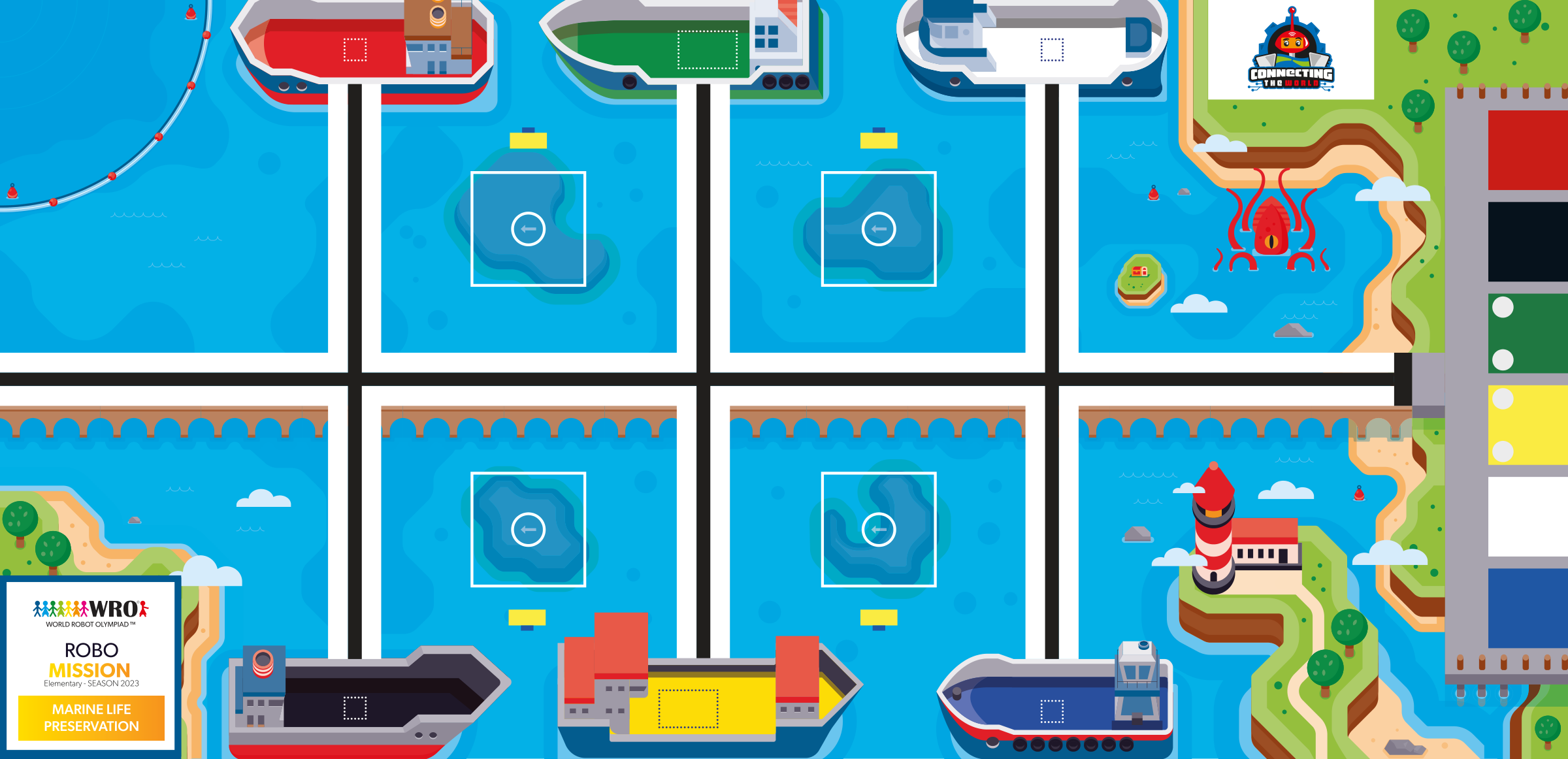
WRO 2023 RoboMission Elementary — Connecting the World — Marine Life Preservation · official WRO game mat, 2362 × 1143 mm
The challenges name these places rather than distances, so the same challenge works on any mat:
Switch mats above and every route below is redrawn on the mat you chose.
Work through them in order — each is harder than the last. The extra challenge comes after all three, and it is meant to make you plan before you build.
Write your four legs as a routing table and mark the points where the robot genuinely knows its heading. Those are your re-zero points.
Build the program from My Blocks with Calibrate Gyro at the top, then dry-run it by hand on the mat before powering up.
Run it and find the FIRST leg that ends wrong. Say whether the robot was pointing wrong or in the wrong place, and fix that one thing only.
Run a four-leg route where every turn is a gyro turn and every straight is heading-held, twice in a row without a reset, placed and calibrated by your own written ritual each time.