Challenge 1
Set the mat up to competition standard. That means flat, taped, on a level table, and lit as it will be on the day. Then run once cold, with no practice first, and write down the score.
Quick Learn — the model, the instructions, the program and the challenges. The theory is in Full Lesson.
EV3 Robotics›Level 4 · WRO Prep›Lesson 24
Level 4 · Lesson 24 · EV3-L04-2460 minutes · Block 3 of 6 · Mat: WRO 2023 — Connecting the World, Marine Life Preservation
Competition conditions on the marine mat — and the first round where most of your navigation has no line under it.
Everything you need exists. Today you find out what four lessons of gyro work are worth. Nobody may help, the clock is running, and the robot has to cross open water to get home.
No coaching during a round. Once it starts, nobody touches the robot or the computer. Anything a teacher would normally call out has to have been built into the placement ritual and the program beforehand.
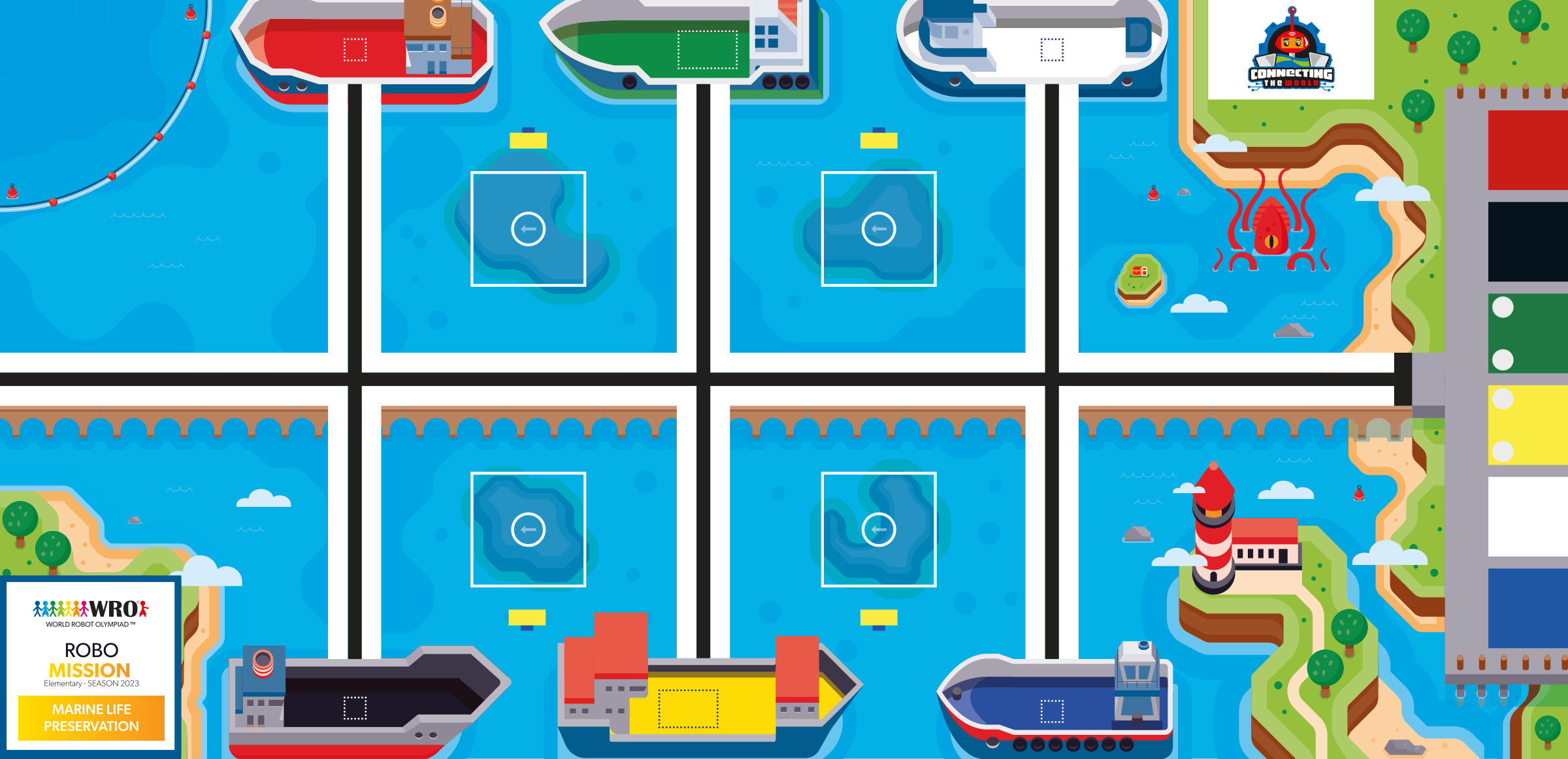
Everything is available today: the four reefs at A, B, C and D, the lighthouse island at E, and the octopus at F. You start and finish at HOME at the harbour dock.
Your lesson 17 budget already said this does not all fit. Run the route you costed, not the route you wish you had time for. A team that improvises a fifth station mid-round usually loses the four it had.
Have your abandon plan ready. It names the mission you said you would drop if you fall behind, and the sign that tells you that you have. Today is when that plan is tested.
Before the first round, work out what you expect this block to have changed. Then find out whether you were right.
Drift grows with time, and rounds are slow. This is the one that catches teams today. A run that stalls, retries or waits is accumulating heading error the whole time it is not moving. If your round goes badly and the navigation gets steadily worse rather than failing outright, that is what you are watching.
Same discipline as lesson 16, plus one addition that belongs to this block.
The program is finished. Today’s job is to stop changing it and make it survivable under pressure.
Check Calibrate Gyro is the first thing on the canvas. Check the placement ritual from lesson 23 is written where the person placing the robot can read it.
Check your re-zero points are still in the program and still land where the robot genuinely knows its heading. A re-zero that has drifted into open water during last lesson’s debugging is a quiet way to lose a round.
And confirm the program on the Brick is the one you mean to run. Teams lose whole rounds to yesterday’s version.
Between rounds you get two minutes, which is one change and nothing more. Decide what it will be while you are watching the round fail, not afterwards.
On this mat the tempting change is a gain. Consider instead whether the honest fix is a re-zero point or a squaring stop — those remove error, where a gain only manages it.
Make the change, run again, record whether the score moved. If it did not, put it back: an unhelpful change kept out of stubbornness costs you the next round too.
Round one is cold. No practice lap, no warm-up, no last adjustment. Place the robot by the ritual, calibrate, start, hands off. Score it.
Two minutes. One change. Round two. Score it.
During both, have somebody watch specifically for where the robot ends up versus where it is pointing. That distinction was lesson 23’s diagnostic and it is the most useful thing an observer can record.
The last lesson of a block collects the block:
That last line is Block 4’s starting point. A long straight may still wander, or the follower may still fail at speed. If so, PID in lessons 28 and 29 is the answer. Lesson 30 then tests basic, proportional and PID side by side on one leg. It needs today’s numbers to do that.
This model drives, so its challenges are run on a mat. Mats differ between branches — check you are looking at the one in your room.
WRO 2023 RoboMission Elementary — Connecting the World — Marine Life Preservation · official WRO game mat, 2362 × 1143 mm
The challenges name these places rather than distances, so the same challenge works on any mat:
Switch mats above and every route below is redrawn on the mat you chose.
Work through them in order — each is harder than the last. The extra challenge comes after all three, and it is meant to make you plan before you build.
Set the mat up to competition standard. That means flat, taped, on a level table, and lit as it will be on the day. Then run once cold, with no practice first, and write down the score.
You get two minutes between rounds. Change exactly one thing, run again, and write down whether the score moved. If it did not, put it back.
Ask an observer to watch every failure in both rounds. For each one, they write down whether the robot was pointing the wrong way or in the wrong place.
Score the 2023 marine set in a timed round. Then write in your journal what the gyro gained you. Compare turn accuracy with your numbers from Lesson 14, and say whether the open crossing worked at all. Name plainly the leg that is still not good enough.