Challenge 1
List every scoring action on the farming set as its own row: what the robot must physically do, what it is worth, and what it depends on.
Quick Learn — the model, the instructions, the program and the challenges. The theory is in Full Lesson.
EV3 Robotics›Level 4 · WRO Prep›Lesson 25
Level 4 · Lesson 25 · EV3-L04-2560 minutes · Block 4 of 6 · Mat: WRO 2024 — Earth Allies, Sustainable Farming
Plan the farm — and decide which legs are worth being fast on.
You have costed a route before. Today adds one question on top: of all the legs in your plan, which ones would actually give you seconds back if the robot drove them harder?
Speed is not free and not uniform. Making a short hop between neighbouring stations faster saves almost nothing and risks overshooting the station. Making a long diagonal faster can save real time. A team that tunes every leg for speed will spend this entire block tuning.
Seven stations, and this time they reach every corner of the mat:
Notice the shape. HOME and F are diagonally opposite, as are E and B. Those diagonals are the longest journeys on the mat. Meanwhile A and B sit near each other along the top, and C is central enough to be a short hop from almost anywhere.
So this mat has two completely different kinds of leg, and they want different things from the robot. That contrast is what the whole block is built on.
Take each leg of your route and ask three questions. The answers decide where the rest of this block gets spent.
Fast and reliable are in tension, and this block makes you pick a point on that line. Lesson 31 asks for the fastest settings that still finish ten runs out of ten — not the fastest single run. A setting that wins once and fails twice is worth less than a slower one that always finishes.
Now mark, on your route card, the one leg worth the fastest possible following. One. Usually a long diagonal — the loading yard down to the packing table, or the compost heap up to the vegetable stall.
That leg is not just a planning note. It is the leg lesson 27 will break proportional control on, lesson 30 will race three followers over, and lesson 31 will push to its limit. Choose it deliberately and write it in the journal.
Three artefacts today, and lesson 26 needs the third.
One — the costed route card. As in lesson 17: station order from HOME back to HOME, a time beside every leg and action, a total inside the round, and the missions you cut.
Two — the speed marking. Beside each leg, write fast, careful or short. Exactly one leg gets marked as the fast leg.
Three — the attachment sentence. Different from previous blocks in one specific way: this mat wants one attachment that serves two missions, so that nothing has to be swapped mid-run. Your sentence must say what both jobs are and what shape does both.
Pseudocode again, written in your My Block names. After three blocks the vocabulary is large — Follow Line, Move Straight, Turn By Degrees, Square Up, Collect, Calibrate Gyro — and most of the farm route is already expressible.
Then annotate each call with the speed marking from your route card. Follow Line takes a speed input, which you added in lesson 14, so a careful leg and a fast leg are the same block with different numbers.
That is the reward for lessons 13 and 14 arriving when they did. This block can spend its time on control theory rather than on plumbing, because the plumbing was finished two blocks ago.
Three questions, answered as a team and written down:
Block 3’s robot on the mat at HOME, pushed by hand along the planned route while somebody reads the pseudocode and a third person times it.
Time the marked fast leg on its own as well as the whole route. That single number is the one this block will move, and you want to know where it started.
Today’s entry opens Block 4:
Bring Block 1 and Block 2’s follower times. Lesson 30 puts the two-state follower from lesson 5, the proportional one from lesson 12 and the PID one from lesson 29 side by side over one leg. Those old numbers are two thirds of that table.
This model drives, so its challenges are run on a mat. Mats differ between branches — check you are looking at the one in your room.
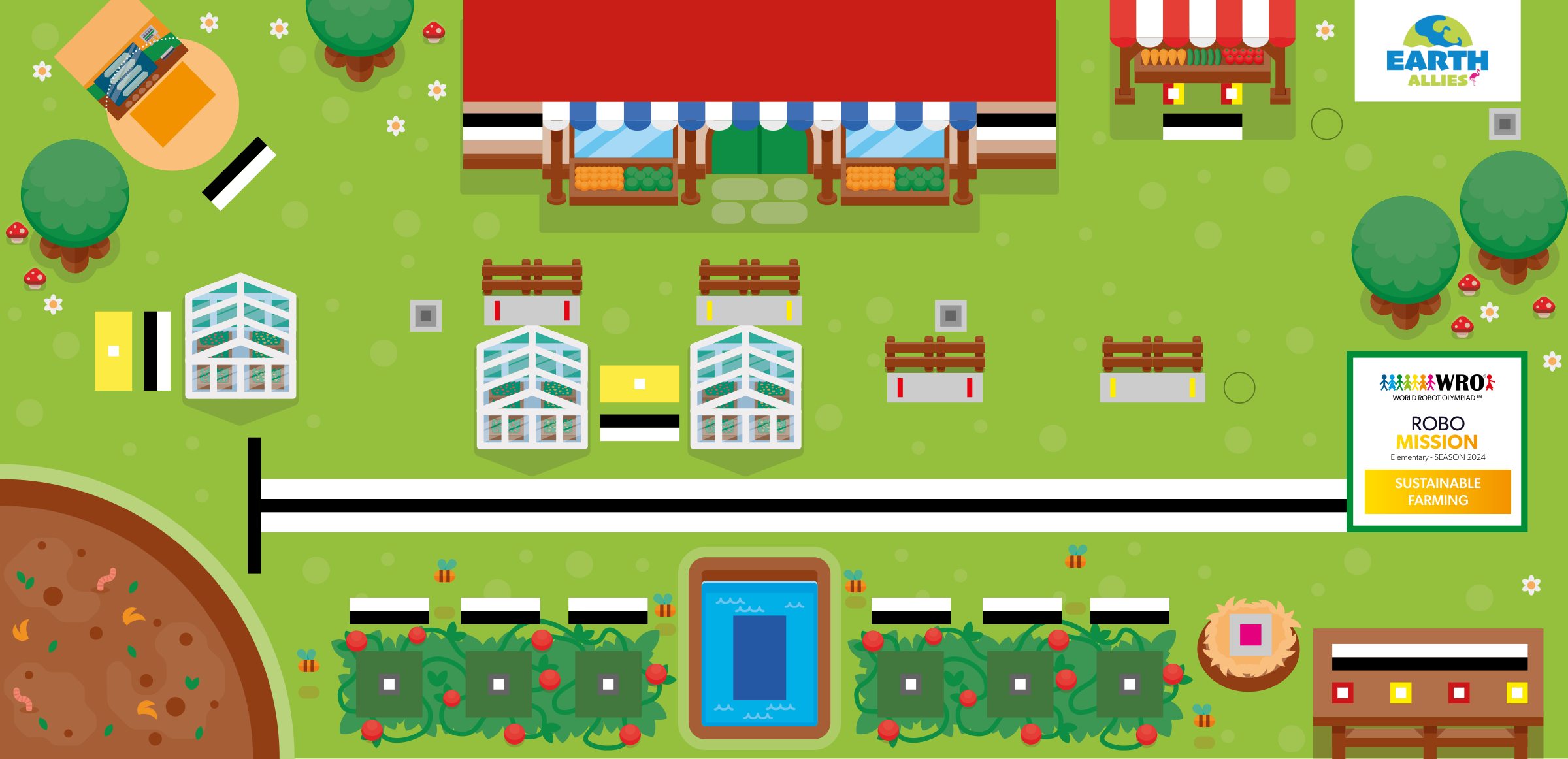
WRO 2024 RoboMission Elementary — Earth Allies — Sustainable Farming · official WRO game mat, 2362 × 1143 mm
The challenges name these places rather than distances, so the same challenge works on any mat:
Switch mats above and every route below is redrawn on the mat you chose.
Work through them in order — each is harder than the last. The extra challenge comes after all three, and it is meant to make you plan before you build.
List every scoring action on the farming set as its own row: what the robot must physically do, what it is worth, and what it depends on.
Cost the route you want to run in seconds, using the times you measured in Block 3 — setup, each leg, each station action — and total it against the round length.
It will not fit. Cut missions by points per second until the budget balances, then mark every remaining leg fast, careful or short — and mark exactly ONE as the fast leg.
Produce a costed route card for the farming set: the station order from HOME back to HOME, a time beside every leg and every action, a total that fits inside the round, and the one sentence saying what two missions a single attachment must serve. Walk it by hand, and time the marked fast leg on its own — that number is what this whole block will move.