Challenge 1
Set the mat up to competition standard — flat, taped, level table, lighting as it will be on the day, battery charged — then run once cold with no practice first, and record the score and the time.
Quick Learn — the model, the instructions, the program and the challenges. The theory is in Full Lesson.
EV3 Robotics›Level 4 · WRO Prep›Lesson 32
Level 4 · Lesson 32 · EV3-L04-3260 minutes · Block 4 of 6 · Mat: WRO 2024 — Earth Allies, Sustainable Farming
Competition conditions on the farm — with settings you already proved.
This round is different from the three before it. You are not finding out whether the robot can do the route; you established that yesterday, ten times. You are finding out whether a number proved in practice survives a cold start, a clock, and nobody allowed to help.
Nothing gets retuned before round one. The settings you certified in lesson 31 are the settings you race. If they fail today, that is information worth far more than a last minute adjustment that hides it.
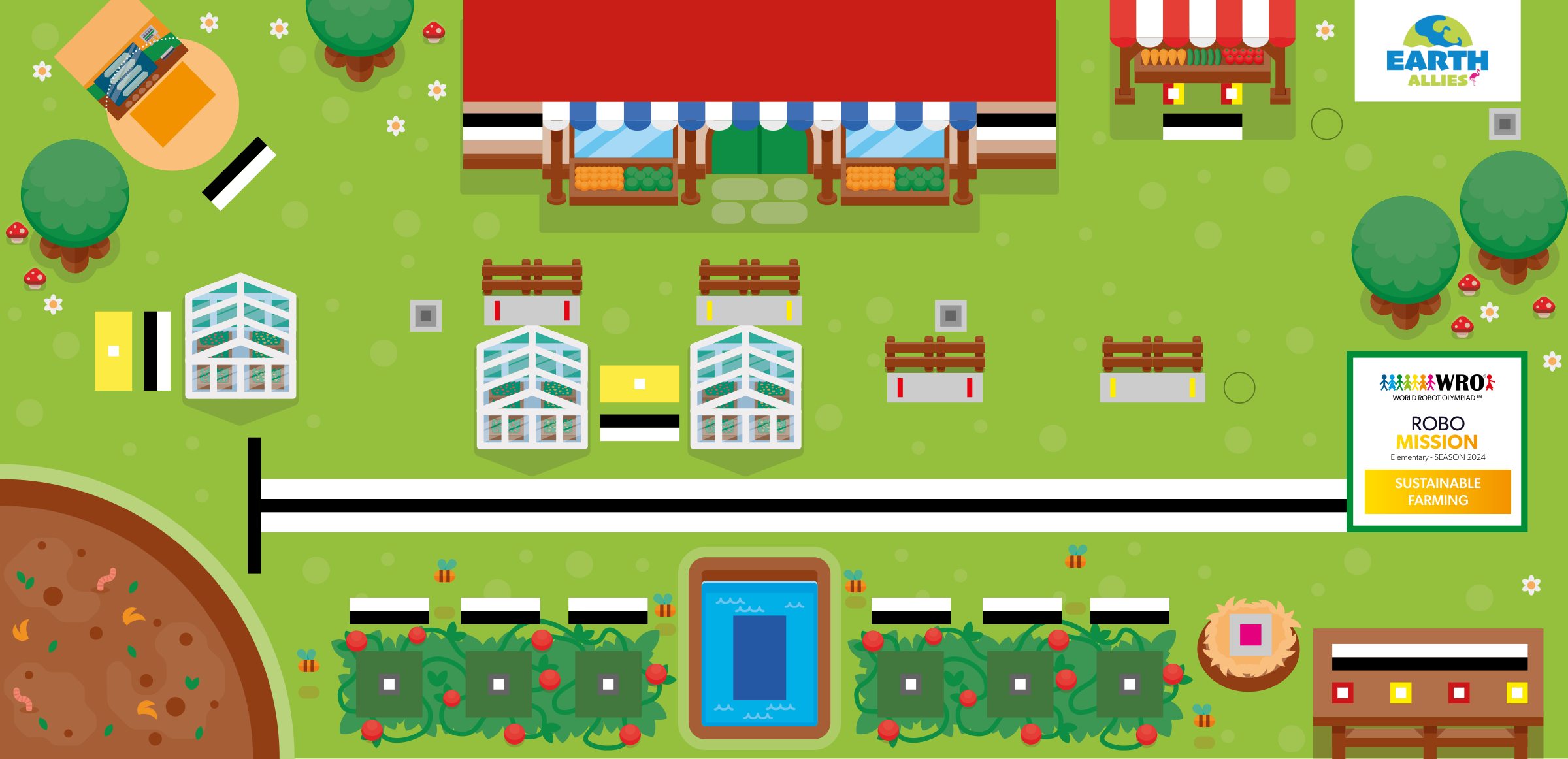
Everything is live: the market barn at A, the vegetable stall at B, the greenhouses at C, the pond at D, the compost heap at E and the packing table at F, with HOME at the loading yard to start and finish.
Run the lap you certified, not the one you wish you had time for. A team that adds a station mid-round usually loses the ones it had — and today it also throws away the only reliability evidence it owns.
Have your abandon plan to hand: the mission you drop if you are behind, and the signal that tells you that you are.
Before round one, write down what you expect this block to have changed. Then find out.
Cold starts are where certified settings go wrong. Yesterday’s ten runs were back to back, with a warm battery and a robot already on the mat. Round one is cold. If the round is worse than every one of those ten, suspect the battery and the placement before you suspect the gains.
The same discipline as the previous three mocks, plus one addition:
The program is finished. Today’s job is to stop touching it and to make sure the right version is on the Brick.
Check the four things this block added: Calibrate Gyro runs first, the I accumulator resets at the start of every Follow Line call, each leg uses the follower and speed you assigned in lesson 30, and the gains are the ones you certified in lesson 31 — not a variant somebody was experimenting with afterwards.
That third one is the easiest to lose. Assignments made on paper in lesson 30 sometimes never reached the program, and the lap that got certified was whatever was actually running. Check the program, not the route card.
And confirm the placement ritual from lesson 23 is written where the person placing the robot can read it.
Two minutes between rounds, which is one change. Decide it while you are watching the round fail, not afterwards.
On this mat the tempting change is a gain, and it is usually the wrong one. Your gains were proved ten times yesterday. What was not proved ten times is the cold start, the battery level, and the placement.
If a leg genuinely failed on following, drop that one leg’s speed rather than retuning. It is the smallest change that addresses the actual failure, and it does not put a certified number at risk two minutes before a scored round.
Make the change, run again, record whether the score moved. If it did not, put it back.
Round one is cold. No practice lap, no warm-up, no last adjustment. Place by the ritual, calibrate, start, hands off. Score it and time it.
Two minutes. One change. Round two. Score it and time it.
During both, have somebody record which leg each failure happened on, in the same language as yesterday’s reliability sheet. That makes today two more rows of the same evidence rather than a separate story.
The last lesson of a block collects the block — and this one is halfway:
That is 32 of 48 — the middle of Level 4. You have a controller you can tune from first principles, a robot that navigates without a line, and a habit of proving reliability rather than claiming it. Blocks 5 and 6 add less that is new and demand much more of what you already have, on the 2025 mat and then on this season’s, deliberately last.
This model drives, so its challenges are run on a mat. Mats differ between branches — check you are looking at the one in your room.
WRO 2024 RoboMission Elementary — Earth Allies — Sustainable Farming · official WRO game mat, 2362 × 1143 mm
The challenges name these places rather than distances, so the same challenge works on any mat:
Switch mats above and every route below is redrawn on the mat you chose.
Work through them in order — each is harder than the last. The extra challenge comes after all three, and it is meant to make you plan before you build.
Set the mat up to competition standard — flat, taped, level table, lighting as it will be on the day, battery charged — then run once cold with no practice first, and record the score and the time.
You get two minutes between rounds. On this mat the tempting change is a gain and it is usually the wrong one: your gains were proved ten times yesterday, but the cold start, the battery and the placement were not. If a leg genuinely failed on following, drop that one leg's speed. Run again and record whether the score moved.
Have an observer record which leg each failure happened on, in the same language as lesson 31's reliability sheet, so today becomes two more rows of the same evidence rather than a separate story.
Score the 2024 farming set in a timed round, then journal what PID bought — round time against Block 3's mock, and the fast leg against its walked time in lesson 25 — whether the certified settings held and what the honest cause was if they did not, whether the one-attachment design ever needed touching, and the leg that is still not good enough. That closes Block 4 and the middle of Level 4.