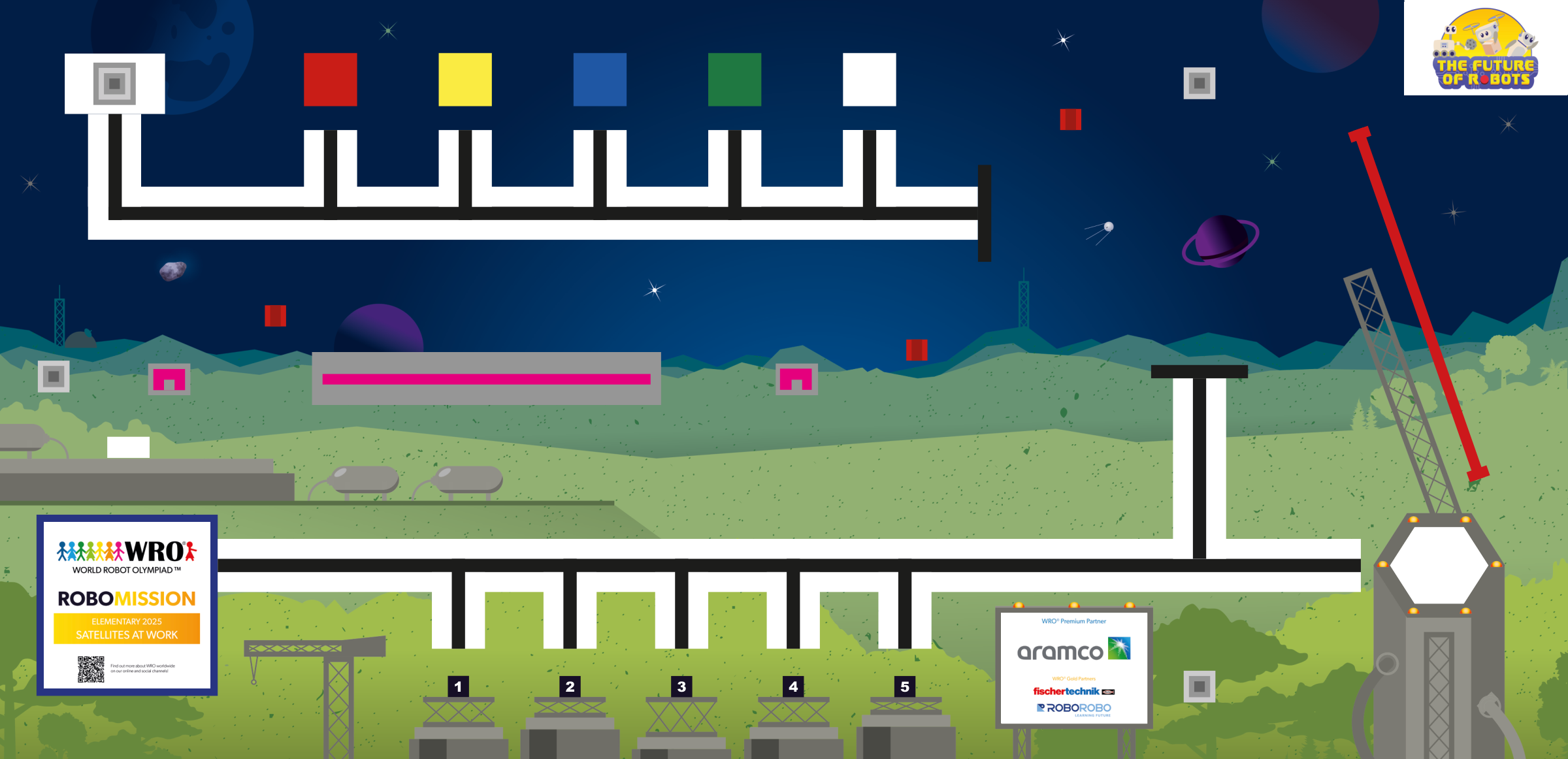
The mission 4 min
Competition conditions — and you do not find out which mission until just before the round.
Every mock round so far let you run the route you had practised. Today the mission is drawn at random in front of you, minutes before you start. That is what a real round does, and it is the reason this block exists.
This is the payoff. The menu has been a convenience you were asked to build. Today it is the only reason you can start at all. A team still carrying six separate programs finds out today what it costs to load the right one with a scorer waiting.
The whole launch site 5 min
Everything is live: launch pad 1 at A, pad 3 at B, pad 5 at C, the launch gantry at D, and the satellite row at E, from HOME in the bottom-left corner and back to it.
How the draw works. Write each mission from your menu on a slip. Somebody from another team draws one, reads it aloud, and the setup clock starts at that moment. No warning, no discussion beforehand.
Draw again, separately, for round two. It may come up the same. That is what random means, and a team that assumes it will be different is making the same mistake as a team that assumes it will be the same.
What the menu actually bought 12 min
Before the first draw, write down what you expect this block to have changed. Then find out.
- Setup should be short. Draw, fit the right module, place, choose from the menu, hands off. No computer.
- Any mission should be reachable. Whatever is drawn, you can run it — that is lesson 39’s milestone under pressure.
- Round two should cost nothing extra. No reload, no rebuild. This is where the modular build from lesson 34 is paid for.
- The robot should tell you what it did. The summary screen from lesson 37, compared against the scorer before you leave the table.
Setup time is scored today, in its own right. From the draw being read aloud to hands off the robot. Time it. It is a number this block should have made small, and it is the clearest evidence of whether the architecture works.
Build it — set the venue up 10 min
The same discipline as the previous four mocks, plus two that belong to this block:
- Mat flat, edges taped. Level table.
- Lighting as it will be on the day, colour calibration re-run if it has changed.
- Battery charged. Your Block 4 settings were tuned near the edge of what the robot can do.
- Both modules on the table, next to the robot, with their configuration cards. Not in a box, not in a bag.
- The draw slips prepared and a neutral person to draw them. One slip per menu entry.
- Timekeeper and scorer from another team, timing setup as well as the round.
Program it — freeze it 12 min
The program is finished. Today’s job is to stop touching it and confirm the right version is on the Brick.
Check the six initialisations from lesson 39 are all present and all at the top: both log lists emptied, the menu choice set, the window start set, the synch flag false, the gyro calibrated.
Check every menu entry has a working mission behind it. An entry that does nothing is a slip in the draw container that you cannot run — take it off the menu and out of the container, together, or the two will disagree.
And write the setup ritual down where the person doing it can read it, the way lesson 23 did for placement: draw read aloud, module fitted per the card, robot placed, menu entry selected, selection read back aloud by a second person, centre pressed, hands off. Reading the selection back is five seconds and it is the only check on the one mistake nothing else catches.
Tune it — two minutes, one change 9 min
Two minutes between rounds, which is one change. Decide it while watching the round fail, not afterwards.
This block adds a new class of thing that can go wrong, and it is worth separating before you change anything:
- Did the robot run the wrong mission? That is the menu or the setup ritual — not the route.
- Did it run the right mission badly? That is the route or the tuning, which Block 4 owns.
- Did it behave differently from the practice run? Suspect something that was not reset before suspecting anything else.
Make the change, run again, record whether the score moved. If it did not, put it back.
Run it — the scored rounds 6 min
Draw. Round one is cold. Setup clock from the moment the slip is read aloud. Fit, place, choose, read back, press, hands off. Score it, time the round, and record the setup time separately.
Two minutes. One change. Draw again. Round two. Score it, time it, record the setup.
After each round, read the robot’s own summary off the screen and compare it against the scorer’s sheet before leaving the table. If they disagree, that is a conversation to have while the mat is still set up.
The journal — closing Block 5 4 min
The last lesson of a block collects the block:
- what was drawn each round, and both scores and round times
- both setup times, from draw to hands off — the headline number for this block
- whether the robot ever ran a mission other than the one chosen, and why
- whether the robot’s summary matched the scorer’s sheet
- the menu design — how many entries, clamp or wrap, how many presses to the furthest one
- what the menu saved between runs, against what six separate programs would have cost
That is 40 of 48. One block left, and it is on the 2026 mat — this season’s, deliberately last, so the final tournament runs on the mat that actually matters. Block 6 teaches almost nothing new. It takes the robot, the controller, the architecture and the habits you now have, and asks you to compete with them.