The mission 4 min
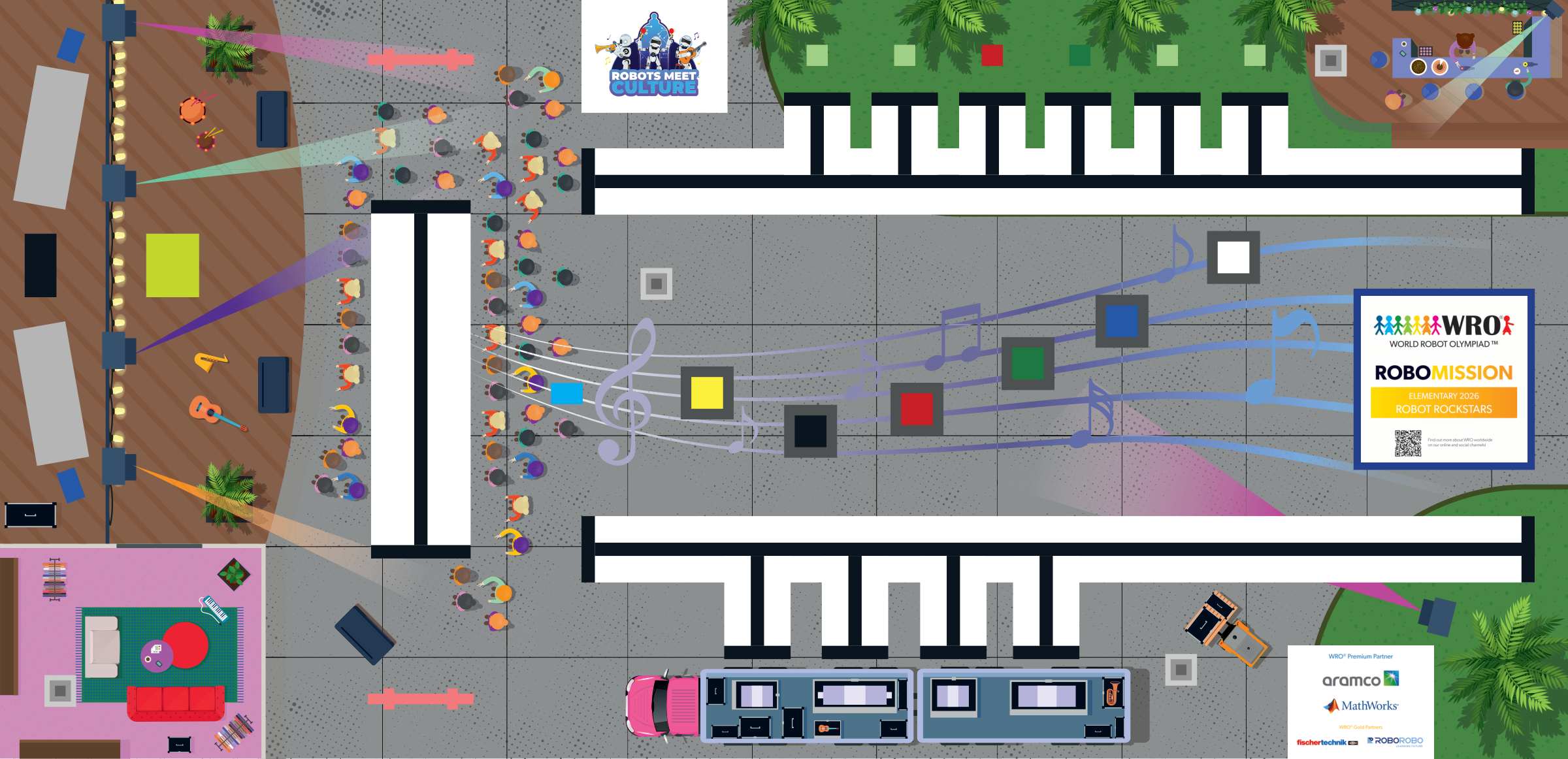
This is the current mat, and this block ends in a tournament on it.
The five mats before this one were retired seasons. That was deliberate — you could fail on them freely, and you did, which is how you learned. This one is live. It is the mat your branch runs by default, and lesson 48 is a scored tournament on it.
Nothing is scaffolded today. You have planned a mat four times: costing actions in lesson 9, a time budget in 17, the fast leg in 25, fixed against variable in 33. Today uses all four at once, on the whole set, and nobody walks you through it. That is the assessment.
Robot Rockstars 5 min
Six stations, and their positions decide most of your route:
- HOME — the room, bottom left. Start and finish.
- A — the concert stage, on the left edge directly above HOME.
- B — the tour trucks, bottom middle.
- C — the café, top right corner.
- D — the park strip, along the top, close to C.
- E — the main plaza, dead centre.
Three features of that layout are worth naming before you plan:
HOME to the concert stage is a clean vertical. Same left edge, straight up. It is the easiest leg on the mat and the obvious opener.
The café and the park strip are neighbours. Close together along the top right, so doing one and not the other wastes most of the journey that got you there.
The plaza is dead centre. It is on the way to almost everything, which makes it cheap to add — and easy to over-value. Being convenient is not the same as being worth points.
The technique — all four skills at once 12 min
Get out the four journal entries. You are going to use every one of them in the next half hour.
- From lesson 9 — cost every scoring action. One row each: what the robot must physically do, what it is worth, what it depends on.
- From lesson 17 — build the time budget. Seconds beside every leg and action, totalled against the round.
- From lesson 25 — mark the legs worth being fast on. Not all of them are, and this block has no time to tune the ones that are not.
- From lesson 33 — split fixed from variable. Whatever this season randomises decides how much of the set the menu has to cover.
Points per second is the only ranking that matters. A station that is convenient, or that you have practised, or that your attachment happens to suit, is not thereby worth doing. Rank honestly, then cut from the bottom until the budget fits.
Pay particular attention to the café and the park strip. Because they are neighbours, they should be costed as a pair — the expensive part is getting to that corner at all, and once you are there the second one is nearly free. Costing them separately makes both look bad and you will cut a mission that was worth doing.
Build it — on paper 10 min
Four artefacts. Lesson 42 rebuilds the robot from nothing and these are the only defensible basis for that redesign.
One — the scoring table. Every action, its points, its time, and its points per second, ranked.
Two — the route card. Station order from HOME back to HOME, times beside every leg and action, a total inside the round, and the missions you cut with what they were worth.
Three — the physical requirements list. This one is new, and it is what tomorrow needs: for every mission you kept, what must the robot physically be able to do? Reach a height, hold something, push, carry two things at once, fit through a gap. Write it as verbs, not as attachment designs.
Four — the menu list. The runs your program will offer, if this season varies. If it does not, say so and skip it — but check the rules rather than assuming.
The program — what you already own 12 min
Write the route as pseudocode in your My Block names, then mark every call with where it came from. After five blocks that list is long: Follow Line with its PID gains, Move Straight under heading hold, Turn By Degrees, Square Up, Calibrate Gyro, Collect, Log Stop, and the whole menu.
Then mark the parts you do not own yet. Those are the only things this block has to build, and there should be very few.
Almost nothing new is taught from here. Lessons 43 and 44 add a second Brick if you need more than four ports, and 45 adds recovery. Everything else in Block 6 is rehearsal, scrimmage and tournament. If your pseudocode needs a technique nobody has, that is a mission to cut, not a lesson to wait for.
Tune it — the port count 9 min
Count what your physical requirements list actually needs plugged in. One Brick has four motor ports and four sensor ports, and you are already using most of them: drive on B and C, gyro on 2, colour on 3, ultrasonic on 4, a module on A.
That leaves two motor ports and one sensor port. So ask:
- Do the missions you kept need more than that? Two independent mechanisms plus the drive is fine. Four is not.
- Could one mechanism do two jobs? Lesson 26’s question, and it is still the cheapest answer.
- Could a module swap between runs cover it? Lesson 34’s answer, and it costs no ports at all.
Only if all three answers fail do you need a second Brick — which is what lessons 43 and 44 are for. Decide today, because it changes what you build tomorrow.
Run it — the walk-through 6 min
Block 5’s robot at HOME, pushed by hand along the planned route, somebody reading the pseudocode, a third person timing.
Time the whole route and each leg. Compare the total against your budget — if the walk is already over the round length, the plan is wrong now, while it is still free to change.
Then walk the top-right corner deliberately: up to the park strip at D, across to the café at C, and back out. That corner is where teams lose time they did not plan for, because two stations that look adjacent on paper still need a turn and a squaring stop between them.
The journal 4 min
Today’s entry opens the last block:
- the mat sketch, corrected in colour
- the scoring table, ranked by points per second
- the route card, with the cut missions and what they were worth
- the physical requirements list, written as verbs — this is what tomorrow’s redesign answers
- the port count, and whether you need a second Brick
- the walked total against the budget
Keep this entry intact. Lesson 48 submits the journal to a judge, and WRO scores documentation alongside the run. A planning page that shows a ranked table and a cut list with reasons is exactly what a judge is looking for — and it cannot be reconstructed convincingly in week eight.