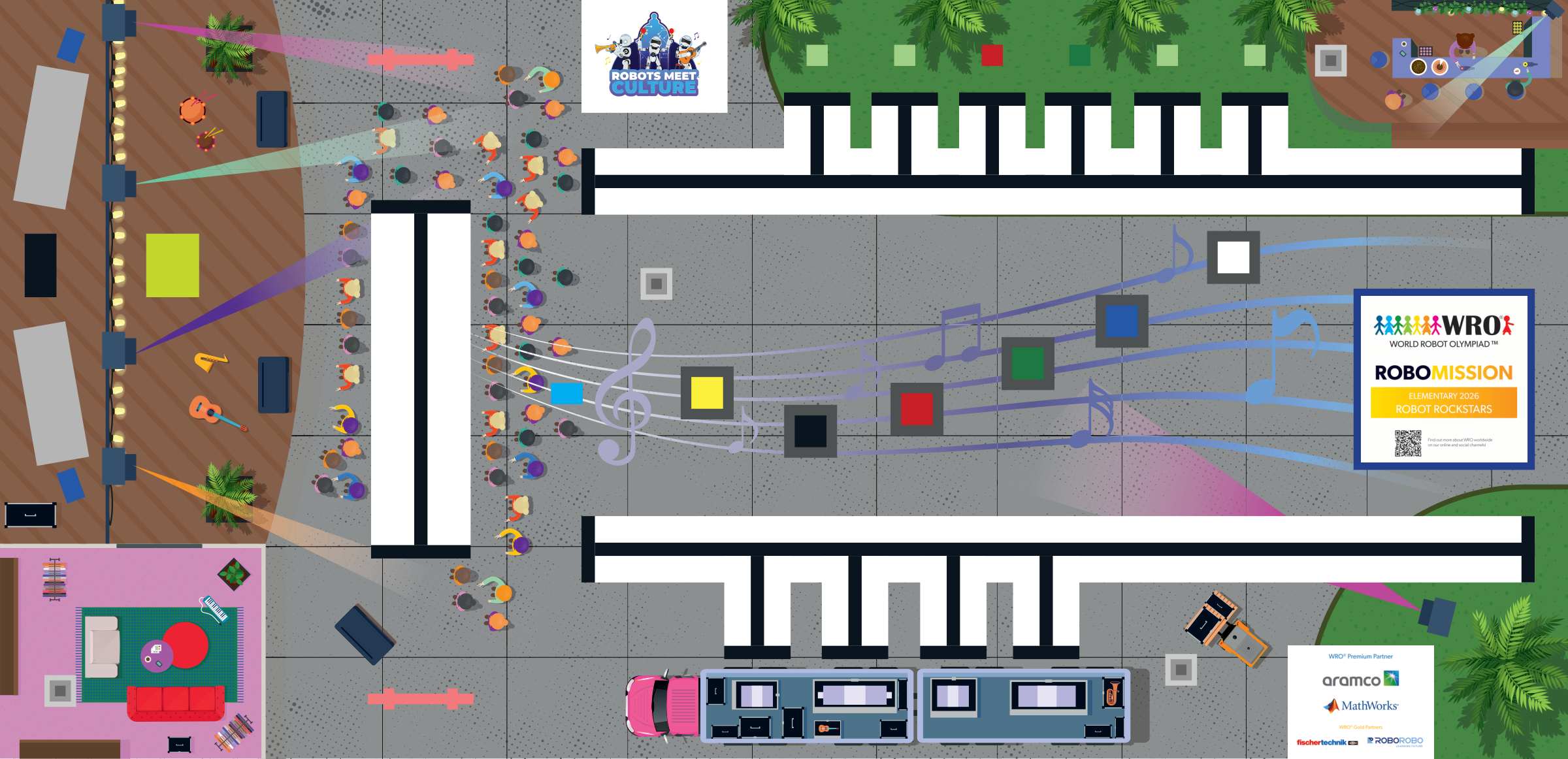
The mission 4 min
The complete set, twice — with no fixes in between.
Every mock round so far gave you two minutes and one change between rounds. Today gives you nothing. Both rounds run the same program, the same gains, the same robot.
That fix window has been carrying you. It lets a robot that is not quite finished look finished, because round two is always allowed to be the repaired version. Take it away and the question becomes the real one: is this robot done?
If round two collapses without the fix, that is worth knowing now. There are two lessons left to act on it, and neither of them is a good place to find out.
The full set 5 min
Everything is live: the concert stage at A, the tour trucks at B, the café at C, the park strip at D, and the main plaza at E, from HOME in the bottom-left corner and back to it.
Run the route you costed in lesson 41 — the one that fits — not the one you wish fitted. Improvising an extra station mid-round usually loses the ones you had.
Have your abandon points to hand from lesson 45: for each mission, where the robot can be left and still reach the next one. Today is the first time those matter under a clock.
Everything at once 12 min
This is the first run with all of it together, and that is the interesting part. Individually every piece works. Today finds out whether they work in the same program.
- The redesigned robot from lesson 42, with whatever its rebuild invalidated re-measured.
- The second Brick, if you have one, with its power-up order in the setup ritual.
- Recovery from lesson 45, which you have triggered deliberately but never yet had fire when you did not expect it.
- The menu and the log from Block 5, including the six initialisations.
- PID from Block 4, at the speeds you certified — which were tuned on a robot that has since been rebuilt.
Expect the interactions to break, not the parts. A recovery that fires and leaves the gyro heading wrong. A log that fills differently when a mission is abandoned. A menu choice that runs a mission whose mechanism moved to the other Brick. Nothing on that list is a bug in one lesson’s work — they are all bugs between two.
Build it — set the venue up 10 min
Full competition standard, and this block adds two items to the list:
- Mat flat, edges taped, level table.
- Lighting as it will be on the day, colour calibration re-run if it has changed.
- All Bricks charged. Both of them, if you have two — a flat slave imitates a broken cable perfectly.
- Modules and configuration cards on the table, beside the robot.
- The setup ritual written out, including the power-up order for the chain and the menu read-back.
- Timekeeper, scorer and observer from another team.
The observer’s job is specific: for every failure, record where on the mat and which kind — lost line, stall, frozen sensor, chain, or none of those. “It went wrong at the plaza” is not a diagnosis.
Program it — freeze it, properly 12 min
The program is finished and today it stays finished. Use this time to check rather than change.
- The six initialisations from lesson 39, all at the top, all present.
- Every menu entry dispatches to a mission that exists — the redesign may have removed a mechanism and left an entry pointing at nothing.
- Every port number is right for where things are actually plugged in now, on both Bricks.
- Every recovery has a timeout, and every timeout ends in abandon and continue, never try again.
- The program on the Brick is the one you mean to run. Teams lose whole rounds to yesterday’s version.
Whatever you find now, fix now. Once round one starts, the program is sealed until the end of the lesson — including between the rounds. That is the whole point of today.
Tune it — the change you are not allowed to make 9 min
Between the rounds you will want to change something. Do not. Instead write it down.
What you would change, and why, decided while watching round one, before round two runs.
Then run round two, and afterwards compare that note against what actually mattered.
That comparison is the most useful thing in this lesson. Teams routinely want to change the most dramatic failure rather than the most expensive one. A note written before round two, checked against round two, tells you whether your instinct under pressure is any good — and that instinct is what you will be relying on in lesson 48.
After both rounds, make the change and run once more, unscored, to see whether it helped. That run is not part of the rehearsal; it is preparation for the scrimmage.
Run it — two rounds, sealed 6 min
Round one is cold. No practice lap, no warm-up. Place by the ritual, power up the chain in the written order, calibrate, choose from the menu, read the selection back, start, hands off. Score it and time it.
Round two follows immediately. Nothing touched. Same program, same gains, same robot. Score it and time it.
Then read the robot’s own summary off the screen after each and compare against the scorer’s sheet before the mat is cleared.
Compare the two rounds against each other. Two similar scores means a robot you can rely on. A good round one and a bad round two means something is not repeatable — and finding out which, with two lessons left, is exactly what today was for.
The journal 4 min
Today’s entry, and lesson 48’s judge will read it:
- both scores and both times, side by side
- the observer’s failure list — where, and which kind
- whether any recovery fired, and whether it helped
- the change you wanted between rounds, written before round two, against what actually mattered
- whether the robot’s log matched the scorer’s sheet
- the difference between round one and round two, and your honest explanation for it
Tomorrow somebody else judges you. The scrimmage scores the run and the documentation together, and a judge will ask why you built what you built. The answers are in the journal you have been keeping since lesson 41 — start reading it back tonight.