The mission 4 min
Run against another team, with a judge scoring the run and the documentation together.
Two things are new today and both are how a real competition works. Somebody else is running beside you, and somebody is reading your journal and asking you about it.
The first way this goes wrong is rushing. Everything that was fine in an empty room — the setup ritual, the menu read-back, the pause before pressing start — now happens while a stranger appears to be doing it faster. Teams match that pace and skip a step. Your ritual takes as long as it takes.
How the scrimmage runs 5 min
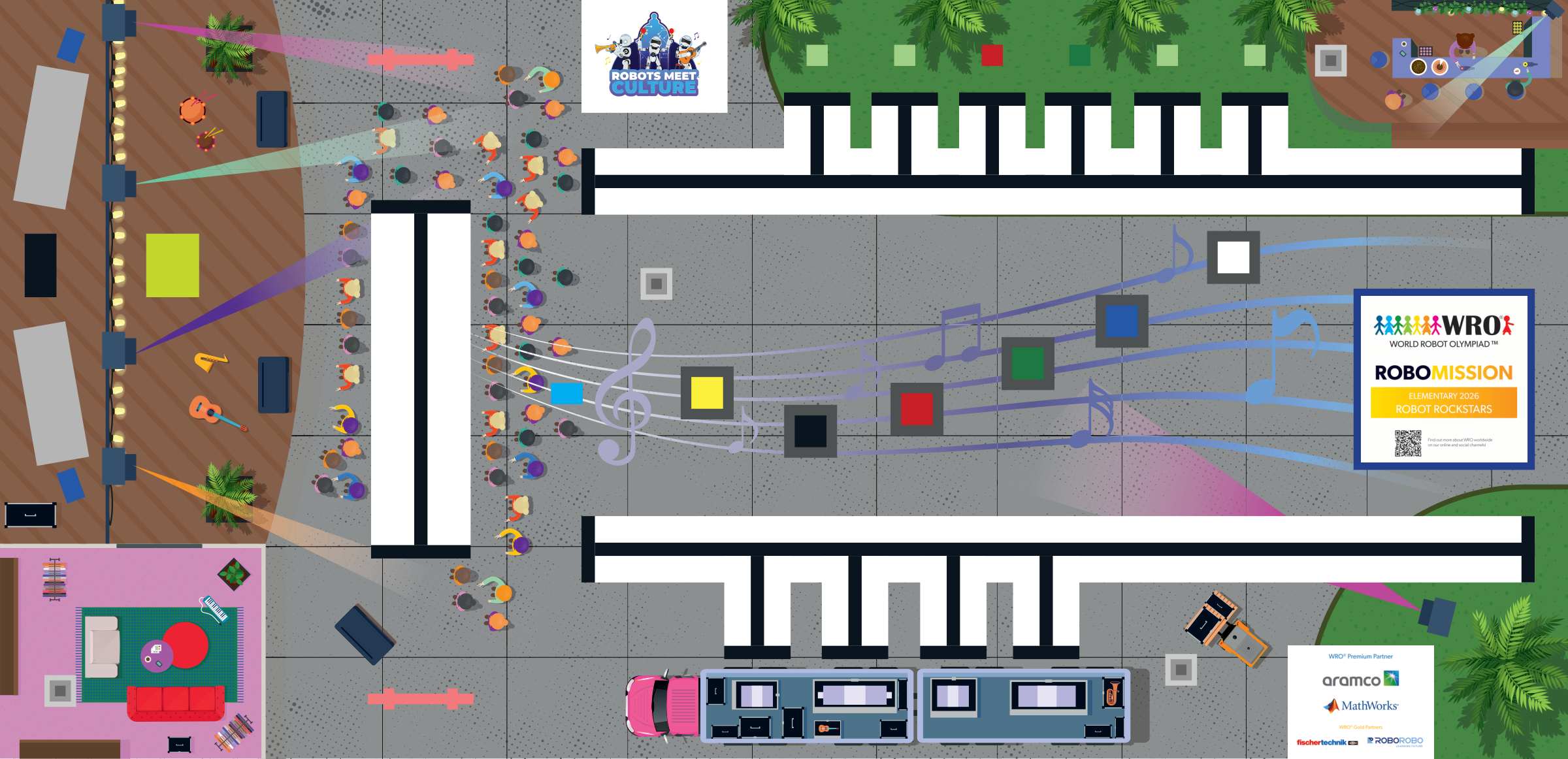
Pair up with another team. Both of you run the full 2026 set — the concert stage at A, the tour trucks at B, the café at C, the park strip at D, the main plaza at E, from HOME and back.
Each team judges the other. You score their run, read their journal and ask them the three questions; they do the same to you. Judging somebody else’s work is what teaches you to read your own.
If you have two mats, run at the same time. If you have one, alternate — but keep both teams at the table throughout, because being watched is the condition being rehearsed.
The three questions 12 min
A judge asks the team, not the robot. All three should be answerable from the journal in under a minute each — and if they are not, that is the finding.
One — why is the robot built this way? Point at any component and ask which line of the scoring sheet it earns. That is lesson 42’s justification table, and it is the question teams most often cannot answer about a robot they built themselves.
Two — what does it do when something goes wrong? Lesson 45. A good answer names the three failures, says how each is detected, and says what the robot does instead of stopping. A weak answer is “it usually works”.
Three — how do you know it is reliable? Not “we tested it”. The answer is numbers: the ten out of ten from lesson 31, the two sealed rounds from lesson 46, the five-run tables. Reliability is a measurement, and by now you have measured it repeatedly.
Documentation is scored because it is evidence of thinking. A judge cannot see the six weeks of decisions behind a robot. The journal is the only record that those decisions were made deliberately rather than arrived at. That is why WRO scores it, and why lesson 41 told you to keep the planning page intact.
Build it — the judging sheet 10 min
Agree one sheet both teams will use, so the judging is consistent.
The run — missions completed and points, round time, setup time from placement to hands off, and whether the robot finished at HOME.
The documentation — is there a mat analysis with costed missions, a robot design with reasons, a record of what was tuned and what the numbers were, and evidence of testing rather than claims of it.
The interview — the three questions, each marked as answered from the journal, answered from memory, or not answered.
Judge the journal before watching the run, so a good round does not flatter thin documentation. Real judging separates them for exactly that reason.
Program it — nothing changes today 12 min
The program is what it is. Use this time on the two things that are actually being tested today.
Rehearse the setup ritual out loud, twice. Placement, chain power-up order, calibrate, module fitted per its card, menu entry selected, selection read back by a second person, start. Under pressure people skip the read-back, and it is the only check on the one mistake nothing else catches.
Rehearse the three answers out loud. Decide who speaks — one person, with the journal open, not three people at once. Find the page for each answer now, so nobody is leafing through a book while a judge waits.
“It is in the journal” is not an answer, and neither is reading a page aloud. A judge wants to hear a team explain a decision and then see the evidence for it. Practise the sentence, then the page.
Tune it — judge the other team 9 min
Now judge properly. Be the judge you would want: fair, specific, and not generous about things that are actually missing.
- Ask the three questions and write the answers down. Mark honestly whether each came from the journal or from memory.
- Point at a component and ask what it earns. Any component. This is the question that separates a designed robot from an accumulated one.
- Ask for a number. “How reliable is that leg?” If the answer has no figure in it, note that.
- Say one thing they do better than you. Take it back to your own team.
Then swap and be judged. Do not defend or explain while being judged — write the questions down instead. The list of questions you could not answer is what you take away from today.
Run it — the scrimmage rounds 6 min
One round each, cold, with the other team watching. Full ritual, no rushing, no coaching once it starts. Score the run and time both the round and the setup.
Then a second round each, with two minutes and one change allowed — the fix window is back today, because a scrimmage is practice for a tournament and a tournament has one.
Compare your setup time against lesson 46’s. If it is shorter, check honestly whether that is because you have got better at it or because you skipped a step while somebody was watching.
The journal 4 min
Today’s entry, written the same day while it is accurate:
- both your round scores and times, and your setup times
- the other team’s judging of your documentation — what they marked as missing
- every question you could not answer, written out
- what you judged missing in theirs — the gaps you spot in somebody else’s work are usually in your own
- the one thing they do better than you
- whether you rushed the ritual, and what it cost
That list of unanswered questions is tomorrow’s work. Lesson 48 is the final tournament and the journal is submitted and scored. Every gap found today can still be filled — but only today, because tomorrow the journal is handed over as it stands.