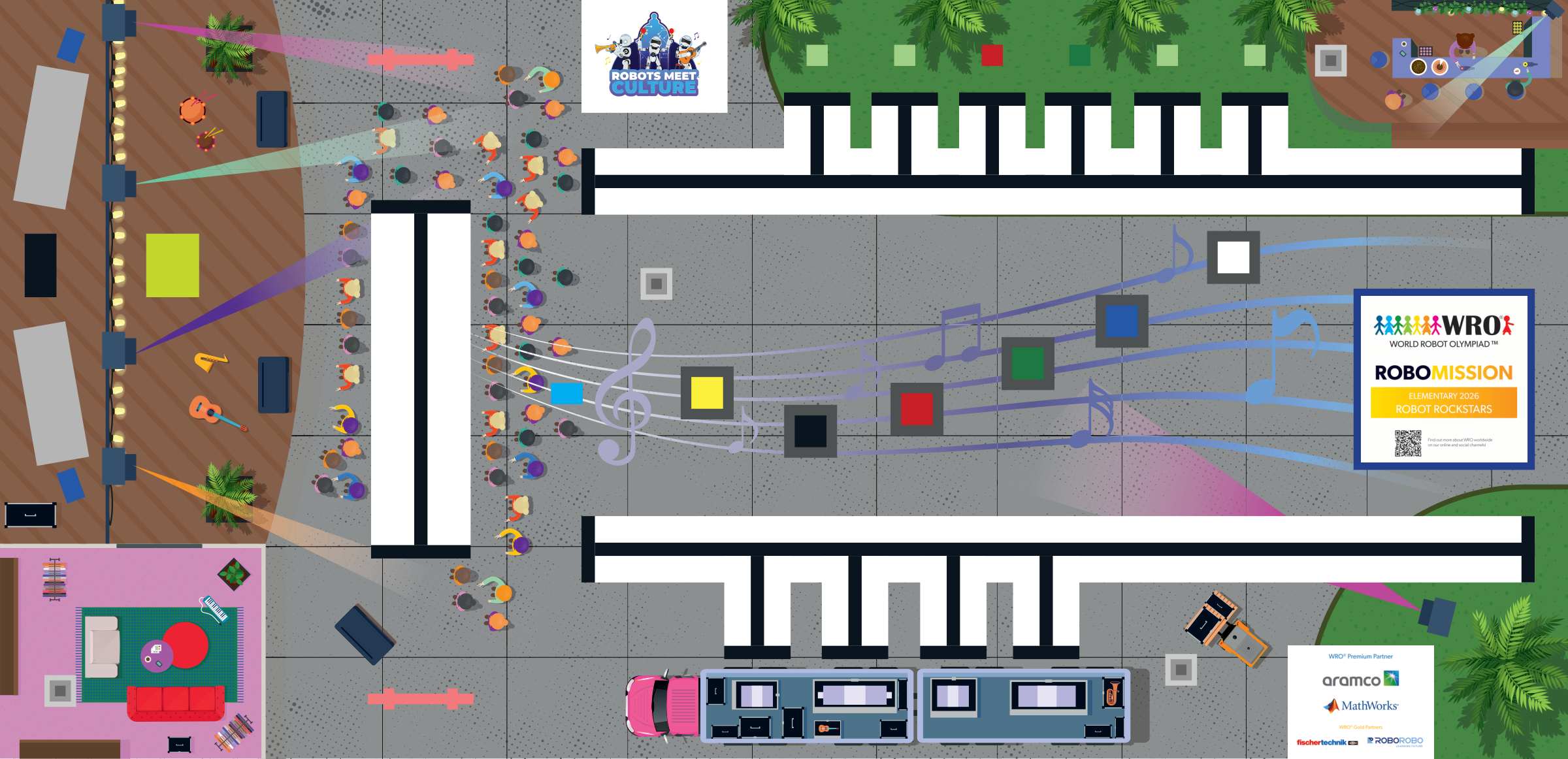
Quick Learn — the model, the instructions, the program and the challenges. The theory is in Full Lesson.
The mission 4 min
The final tournament — and the journal is scored too.
Two deliverables today, marked separately. The robot runs the 2026 set under tournament conditions, and the journal is submitted to a judge who reads it.
The journal is not written today. It has been written since lesson 1 — forty-eight entries of decisions, numbers and things that went wrong. Today it is assembled and handed over. A judge can tell the difference between a record kept as you went and a document produced this morning, immediately and every time.
The final set 5 min
Everything on this season’s mat: the concert stage at A, the tour trucks at B, the café at C, the park strip at D, the main plaza at E, from HOME in the bottom-left corner and back.
Run the route you costed in lesson 41 and rehearsed in lesson 46. Today is not the day to attempt the mission you cut seven weeks ago.
Two scored rounds per team. Full ritual each time. Two minutes and one change between them — the tournament allows it, so today allows it. Independent timekeeper and scorer.
What a judge is actually reading for 12 min
Not neatness, and not length. A judge is looking for evidence that decisions were made rather than arrived at.
- Analysis before building. The costed mission tables, the points-per-second ranking, the missions cut with what they were worth. Lessons 9, 17, 25, 33 and 41.
- Design with reasons. Lesson 42’s justification table: every major component tied to the line of the scoring sheet it earns.
- Measurement, not opinion. The gain sweeps, the three-follower comparison, the reliability sheet, the before-and- after tables. Numbers, with the conditions they were taken under.
- Testing rather than claims of testing. Ten out of ten from lesson 31. The two sealed rounds from lesson 46. The sabotaged round from lesson 45.
- What went wrong, and what you did.
Keep the failures in. This is the most useful advice in this lesson. The instinct is to present only successes. But the gain table that proved no single gain worked, the windup that threw the robot across the mat, the round where certified settings did not hold — those pages are the evidence that you were engineering. A journal of unbroken success reads as fiction, because it is.
Build it — assemble the journal 10 min
Put it in an order a stranger can follow. Six sections, one per block, is the obvious structure and it matches how the work actually happened.
Add two pages at the front, and these are the only things written today:
A contents page. A judge has a few minutes. Make the key evidence findable — the ranked mission table, the design justification, the reliability numbers.
A one-page summary. What the robot does, why it is built that way, and how you know it works. Three short paragraphs. Write it last, because you can only write it once you can see the whole thing.
Then check the questions you could not answer in lesson 47. Every one of those is a gap a judge already found once. Fill what you can in the time you have — that list was yesterday’s homework and this is the last hour it can be acted on.
Program it — the last checks 12 min
Nothing changes. Confirm, in this order:
- The right program is on the Brick, and it is the one that ran in lesson 46 plus whatever you changed after the scrimmage.
- All Bricks charged, including the slave.
- The six initialisations are present.
- Every recovery still has its timeout, ending in abandon and continue.
- The setup ritual is written down and the person performing it has it in hand.
- Modules and configuration cards are on the table.
Resist the last-minute improvement. The single most common way a good team loses a final round is a change made in the twenty minutes before it, untested, to fix something that was not actually broken. What you have was proved over two blocks. Run it.
Tune it — two minutes, one change 9 min
Between your two rounds you get two minutes and one change. By now you know how to choose it, and lesson 46 measured how good your instinct is.
- Wrong mission run? The menu or the ritual.
- Right mission run badly? The route or the tuning — and usually the smallest honest fix is one leg’s speed.
- Stopped dead? A recovery that did not fire, or one without a timeout.
- Nothing on the slave responded? The chain or its batteries, not the program.
- Different from the rehearsal? Something was not reset.
Make the change, run round two, and record whether the score moved. Write that down as well — a judge reading how a team diagnosed a failure under pressure is reading the best page in the journal.
Run it — the tournament 6 min
Journals are handed in before any robot runs. The judge reads them first, so that a good round cannot flatter thin documentation. That is how real judging is ordered and it is the only fair way to do it.
Round one, cold. Full ritual: place, power up the chain in the written order, calibrate, fit the module by its card, choose from the menu, read the selection back aloud, start, hands off. Scored and timed.
Two minutes. One change. Round two. Scored and timed. The better of the two rounds counts.
After each round, read the robot’s own summary off the screen and compare it against the scorer’s sheet before the mat is cleared.
The journal — the last entry 4 min
Write it after the tournament, and write it honestly:
- both round scores and times, and which counted
- the one change between rounds, and whether it helped
- the judge’s feedback on the documentation, written down verbatim rather than summarised
- what you would do differently with another eight weeks — one specific thing, not a wish list
- the single change across the whole course that gained you the most
Forty-eight lessons and six mats. You started with a follower that only knew two states and finished with one you can tune from first principles. You started with one program per route and finished with a menu that runs any mission in the set. You started with a robot that stopped when something went wrong and finished with one that carries on. None of that arrived in a single lesson, which is why the journal is worth as much as the run — it is the only place the whole thing is visible at once.