🎯 Syllabus & Goals 3 min
Cambridge 3.2 · Input and output devices Paper 1 · Computer Systems
By the end of this lesson you can:
- Explain the difference between an LED screen and an LED-backlit LCD screen.
- Describe how an OLED screen works and give its advantages over LCD and LED.
- Describe how digital sound is played through a loudspeaker using a DAC and an amplifier.
Textbook: Chapter 3, §3.2.2 (pp. 107–110) — LED and LCD screens, OLED, loudspeakers.
Recap / Warm-Up 5 min
Last lesson, a DLP projector made colour by mixing red, green and blue. Screens use the same trick. In Unit 1, a 24-bit colour gave each pixel 8 bits for red, 8 for green and 8 for blue.
Quick starter
How many different colours can a 24-bit pixel show?
Reveal the answer
224 = 16 777 216 colours — "over 16 million". Keep this number; it answers an exam question later.
🧠 Key Concept 14 min
1 · LED screens
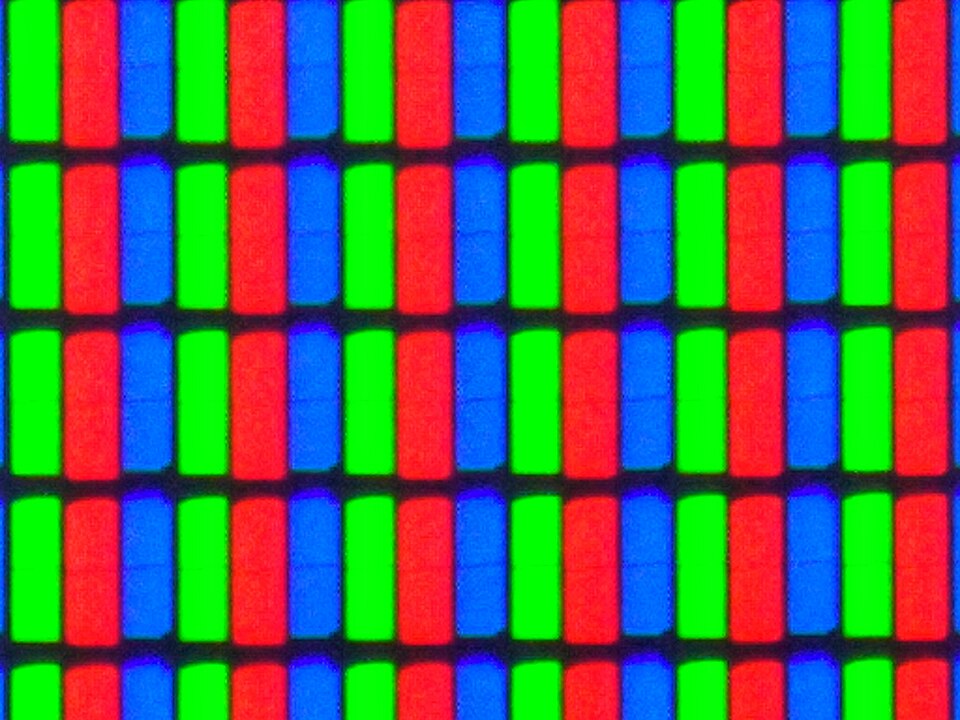
An LED screen is built from tiny light-emitting diodes. Each LED is red, green or blue. Changing the current through each LED changes its brightness. Mixing the three gives a huge range of colours. The colours are brilliant, so true LED screens suit large outdoor displays.

2 · LCD screens — they need a backlight
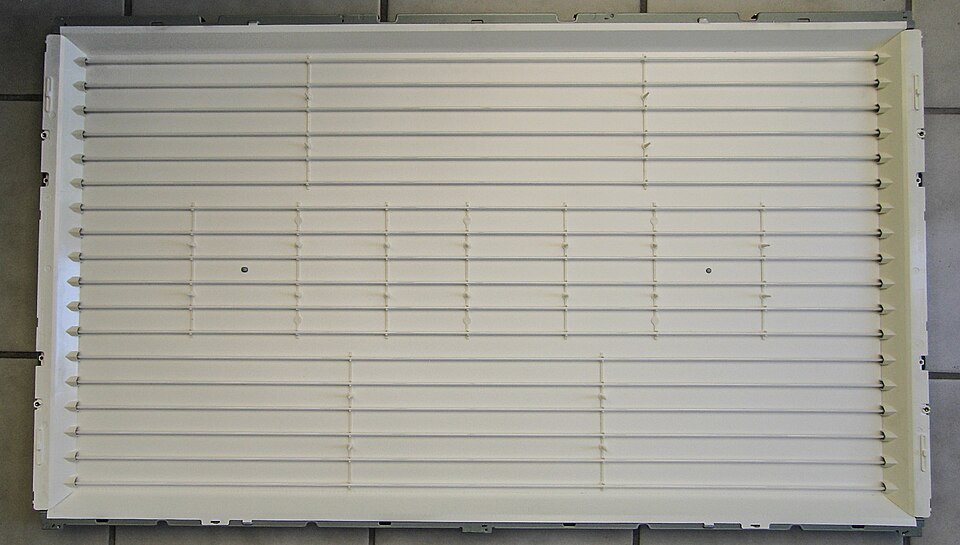
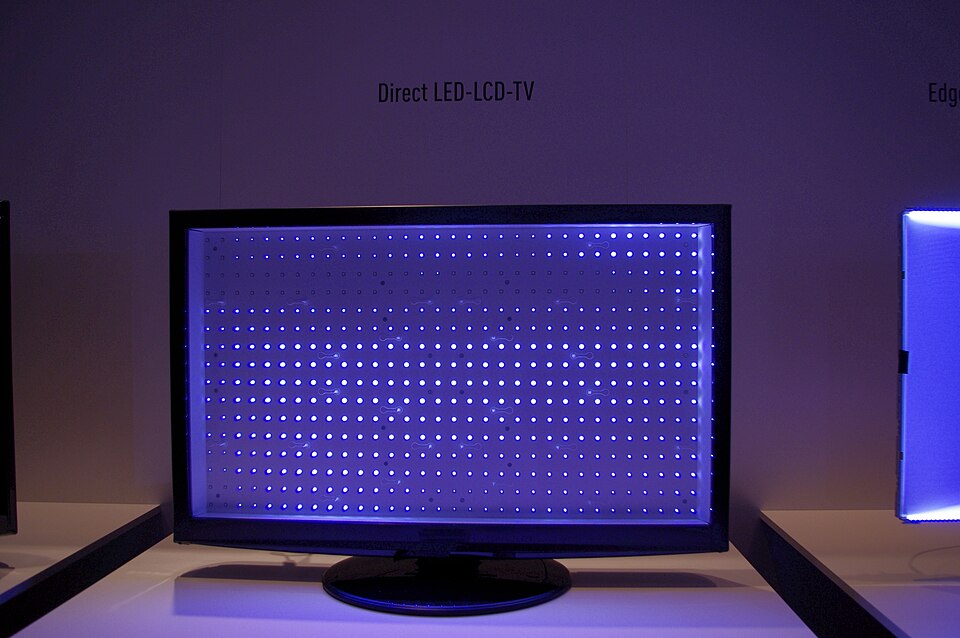
An LCD screen uses tiny liquid crystals arranged as pixels. An electric field changes each crystal so it lets light through or blocks it. The crystals make no light of their own. So every LCD needs backlighting.
- Older LCDs used CCFL — cold cathode fluorescent lamps (tubes) behind the screen.
- Modern LCDs use a matrix of tiny blue-white LEDs behind the screen.
Why LED backlighting replaced CCFL
- Full brightness almost at once — no warm-up.
- Whiter light, so sharper images and more vivid colours (CCFL was slightly yellow).
- Brighter light improves colour definition.
- Much thinner monitors.
- LEDs last a very long time — more reliable, more consistent.
- Very low power, so less heat and less energy used.
Real world · which is which?
- Stadium scoreboard, city billboard → true LED.
- Office monitor, most "LED TVs", laptop → LCD with LED backlight.
- Premium phone, smartwatch, curved TV → OLED.
3 · OLED — organic LEDs
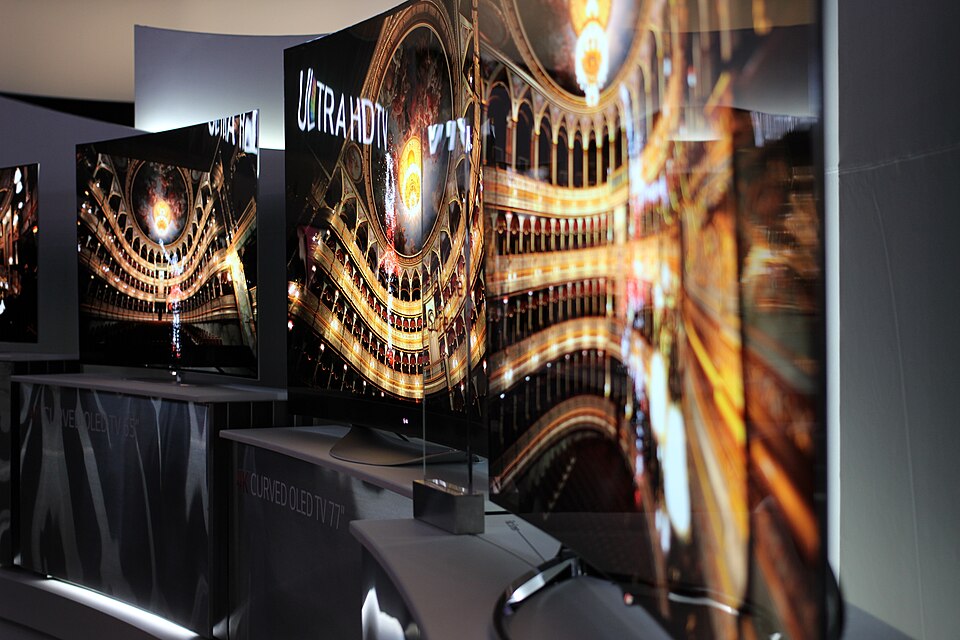
An OLED uses organic (carbon-based) materials. Thin organic films sit between two electrodes: a metallic cathode (negative) and a glass anode (positive). Apply an electric field and the films give off light. No backlight is needed, so the screen can be extremely thin — and even bendable.
OLED advantages over LED and LCD
- Organic layers are thinner, lighter and more flexible than LED/LCD crystal structures.
- Layers can be plastic rather than glass, so lighter still.
- Brighter light than LEDs.
- No backlight needed — OLEDs make their own light.
- So much lower power than LCD — vital for phones on battery.
- Can be made as large, thin sheets (airport advertising).
- Very wide viewing angle — about 170°.
Real world · future uses
Phones that wrap round a wrist like a watch strap. Screens folded into a pocket. OLED panels sewn into outdoor survival clothing, alongside a GPS receiver.
4 · Loudspeakers
Sound stored in a file is digital. A loudspeaker needs a varying analogue current. So three things happen:
- The digital data passes through a DAC (digital-to-analogue converter), becoming an electric current.
- That current is tiny, so an amplifier makes it big enough to drive the speaker.
- The loudspeaker converts the current into sound.
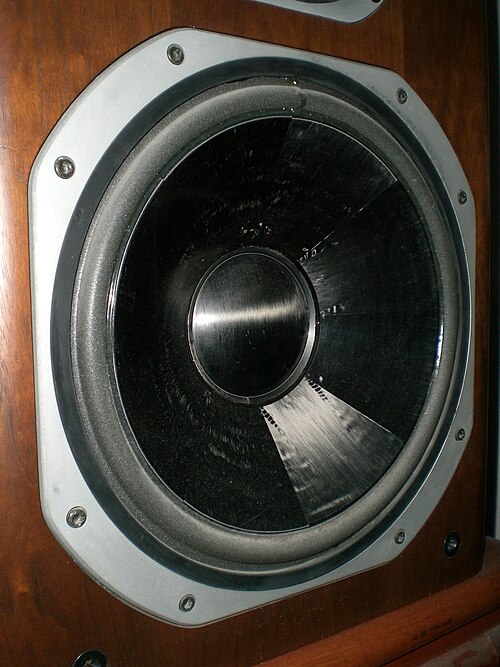
Inside the speaker, current flows through a coil wrapped round an iron core. The core becomes a temporary electromagnet near a permanent magnet. As the current varies, the attraction varies, and the core vibrates. The core is fixed to a paper or plastic cone, which vibrates the air and makes sound waves.
Worked Example 12 min
(a) How many LEDs in a true LED panel?
- Pixels = 1920 × 1080 = 2 073 600.resolution is width × height, as in Unit 1.
- LEDs per pixel = 3 (red, green, blue).a true LED screen lights each colour with its own diode.
- Total LEDs = 2 073 600 × 3 = 6 220 800.multiply pixels by LEDs per pixel.
- Compare a 3840 × 2160 (4K) panel: 8 294 400 pixels × 3 = 24 883 200 LEDs.twice the width and height gives four times the pixels.
That is over six million tiny lights — which is why true LED screens are costly and are mostly used for big outdoor displays.
(b) Playing a song from a file — step by step
- The music is stored as digital (binary) data, e.g. sample values like 1001 0101.state the starting form of the data.
- The data is sent to a DAC, which converts it into an analogue electric current.speakers need a smoothly varying current, not bits.
- An amplifier increases the current.the DAC's output is too small to drive a speaker.
- The current flows through the coil round the iron core, making a varying electromagnet.this is where electricity becomes magnetism.
- Attraction to the permanent magnet varies, so the core and the attached cone vibrate, producing sound waves.vibrating cone → vibrating air → sound.
How the marks are earned: one per step above. Missing the amplifier is the commonest lost mark.
(c) Judging an advertising claim
- With 8 bits per colour channel, a pixel has 224 = 16 777 216 colours.recall 24-bit RGB from Unit 1.
- So "over 1 million" is true — but it greatly understates the real figure.16.7 million is more than 16 times larger.
- "Vivid" is fair: OLEDs give bright light and make their own light, with no backlight bleeding through.link the claim to a real OLED feature.
- "True-to-life" is marketing: the human eye and the source image limit what is seen.a comment question rewards a reasoned judgement, not just facts.
Try It Yourself 12 min
Goal: Put these in order to play a sound: cone vibrates · DAC converts · amplifier boosts · binary data read from file · coil becomes electromagnet.
Goal: A true LED scoreboard is 256 × 128 pixels, with one red, green and blue LED per pixel. How many LEDs does it need? Show your working.
Goal: A phone maker is switching from LED-backlit LCD to OLED. Write a short report giving four reasons, each linked to a feature of the technology.
Hint
Start from "OLED needs no backlight". What does that change? Think thickness, weight, power and battery life, flexibility — then add viewing angle and brightness.
📝 Exam Practice 10 min
Explain the difference between an LED screen and an LED-backlit LCD screen.
Mark scheme
- In an LED screen, each pixel is made of (red, green, blue) LEDs that produce the light (1).
- In an LCD screen, liquid crystals form the pixels but make no light; LEDs behind them only provide the backlight (1).
Modern LCD screens use LEDs for backlighting instead of cold cathode fluorescent lamps (CCFL). Give three advantages of using LEDs.
Mark scheme
- Any three (1 each): reach full brightness almost at once / no warm-up · whiter light, sharper and more vivid image · brighter light, better colour definition · thinner monitors · last longer / more reliable · use less power / produce less heat.
Many phone manufacturers are moving to OLED screens. Give three reasons why.
Mark scheme
- No backlight needed, so they use less power / battery lasts longer (1).
- Thinner and lighter (plastic layers) (1).
- Flexible, so can bend / fold / curve (1).
- Also accept: brighter light · wide viewing angle (about 170°).
Describe how a loudspeaker converts an electric current into sound.
Mark scheme
- Current flows through a coil of wire wrapped round an iron core (1).
- The core becomes a (temporary) electromagnet, near a permanent magnet (1).
- As the current varies, the attraction varies so the core vibrates (1).
- The core is attached to a cone, which vibrates and produces sound waves (1).
🗝️ Recap & Key Terms 3 min
True LED screens light every pixel with coloured LEDs. LCDs only filter light, so they need a backlight — now LEDs rather than CCFL tubes. OLEDs make their own light, so they are thin, flexible and low-power. A loudspeaker needs a DAC and an amplifier before its coil and cone turn current into sound.
- LED screen
- A screen whose pixels are tiny red, green and blue light-emitting diodes that produce the light.
- LCD screen
- A screen of liquid crystals that block or pass light; it needs backlighting (usually LEDs).
- Organic LED (OLED)
- A light-emitting diode using organic layers between a cathode and an anode; it generates its own light, so no backlighting is needed.
- Cathode / anode
- The negative / positive electrode in an OLED.
- DAC (digital-to-analogue converter)
- A device that converts digital data into an electric current that can drive a speaker, motor or actuator.
- Loudspeaker
- An output device that converts an electric current into sound.
Homework 1 min
Task (≤ 15 min): A shop sells two TVs. TV A is advertised as an "LED TV"; TV B is an "OLED TV". Explain to a customer how each one produces its picture, and give two advantages of TV B. [5]
Model answer
- TV A is really an LCD: liquid crystals form the pixels and block or let through light (1).
- The light comes from a backlight of (blue-white) LEDs behind the crystals (1).
- TV B's OLED pixels are organic layers between a cathode and an anode that give off their own light (1).
- Advantage: no backlight, so thinner / lighter / can be curved (1).
- Advantage: uses less power / brighter / wider viewing angle of about 170° (1).