🎯 Syllabus & Goals 3 min
Cambridge 6.1 · Automated systems Paper 1 · Computer Systems
By the end of this lesson you can:
- Define an automated system and name its three hardware parts.
- Describe how sensors, a microprocessor and actuators work together in a control loop.
- Give the advantages and disadvantages of automating an industrial process.
Textbook: Chapter 6, §6.1.1–6.1.2 (pp. 217–221) — industrial applications.
Recap / Warm-Up 5 min
In Unit 3 you met sensors as input devices and actuators as output devices. Unit 6 puts them to work. Every system in this unit is the same three parts, arranged around a different real job.
Quick starter
A sensor in a freezer reads −12 °C. The target is −18 °C. Which part decides to switch the compressor on — the sensor, the microprocessor or the actuator?
Reveal the answer
The microprocessor decides. The sensor only measures. The actuator only acts(it switches the compressor motor on). Decisions always happen in the processor.
🧠 Key Concept 14 min
1 · What is an automated system?
An automated system does a job by itself. It uses hardware and software together. No person needs to press a button each time. People usually still watch it, from a control room.
2 · The three parts and the control loop
- Sensor — an input device. It takes readings of a physical quantity (temperature, pressure, light…) and sends the data on.
- ADC — most sensors give an analogue signal. An analogue-to-digital converter turns it into digital data the processor can use.
- Microprocessor (or computer) — compares each reading with stored / pre-set values and decides what to do.
- Actuator — an output device. It turns an electrical signal into movement: motors, pumps, valves, pistons, solenoids.
| Common sensor | What it measures | Common actuator | What it does |
|---|---|---|---|
| Temperature | How hot or cold | Heater / cooler | Raises or lowers temperature |
| Pressure | Force on a surface / gas pressure | Valve | Opens or closes a pipe |
| Level / flow | How full / how fast liquid moves | Pump | Moves liquid or gas |
| Gas | Escaping or dangerous gases | Motor | Turns wheels, fans, stirrers |
| Radiation / pH / light | Radiation level / acidity / brightness | Piston / solenoid | Pushes, lifts or locks |
3 · Industrial example A — a nuclear power station
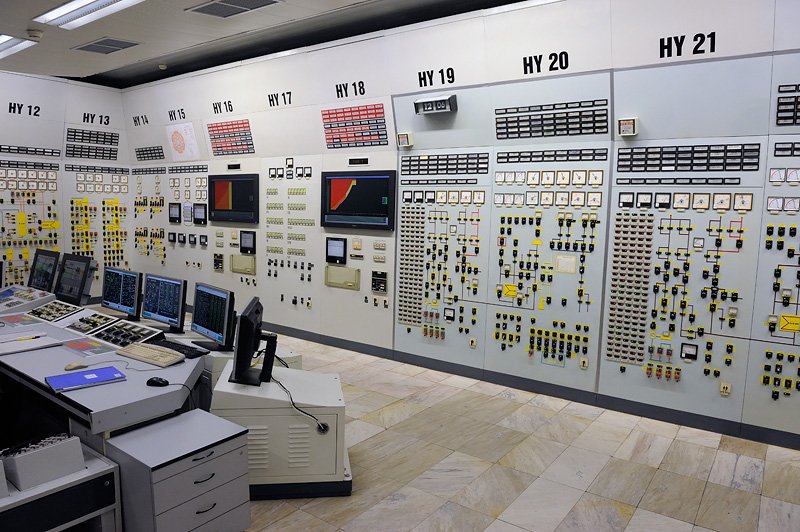
Advantages (nuclear DCS)
- Reacts much faster than a human operator.
- Safer — timely action, and people stay away from danger.
- Runs nearer optimum conditions; small drifts are fixed at once.
- Cheaper in the long run — fewer staff watching 24 hours a day.
Disadvantages (nuclear DCS)
- Expensive to set up and needs a lot of testing.
- Untested conditions could arise — so a supervisor is still needed.
- Any computer system can suffer a cyberattack.
- Needs enhanced (costly) maintenance.
4 · Industrial example B — making a medicine (paracetamol)
Two linked processes run here. Process 1 makes the medicine. Process 2 presses it into tablets. Sensors on both send data to a central computer. The computer checks its database and drives actuators: pumps, valves, heaters, stirrers and pistons.
It shares the nuclear plant's advantages. It adds three more: more efficient use of materials, higher productivity and more consistent results (every tablet the same).
Worked Example 12 min
(a) Keeping a reaction vessel at 80 °C — the loop, step by step
- A temperature sensor in the vessel takes a reading continuously.you must name the sensor — "a sensor" alone rarely scores.
- The analogue reading passes through an ADC, becoming digital data for the microprocessor.processors only handle digital data.
- The microprocessor compares the reading with the stored value 80."compares with a stored/pre-set value" is the single most-awarded phrase.
- If the reading is < 80, it sends a signal to an actuator to switch the heater on.state the condition AND the action.
- If the reading is > 80, it signals the actuator to switch the heater off (or open a cooling valve).the examiner wants both directions.
- The process repeats continuously — the sensor keeps sending new readings.the loop / feedback mark: never forget it.
The same logic in Cambridge pseudocode (one statement per line):
Pseudocode · temperature control loop
// Hold the vessel at the stored target temperature
CONSTANT Target ← 80
DECLARE Temperature : REAL
DECLARE Shutdown : BOOLEAN
Shutdown ← FALSE
REPEAT
  // read the sensor (value already converted by the ADC)
  INPUT Temperature
  IF Temperature < Target
    THEN
      OUTPUT "Heater ON"
    ELSE
      OUTPUT "Heater OFF"
  ENDIF
  INPUT Shutdown
UNTIL Shutdown = TRUE
How the marks are earned: one mark per step 1–6 above. An answer that says only "the sensor tells the computer to turn on the heater" scores 0 — sensors never decide.
(b) Filling in the textbook's analysis table — the paracetamol plant
The textbook advises summarising every scenario in one table. Here it is, worked for Example B.
- Which sensors? Temperature, pressure, level/flow (and weight for tablets).pick sensors that match a quantity the process must control.
- Function of the actuators? Run pumps and stirrers, open/close valves, switch heaters, drive the tablet pistons.actuators always cause physical movement or change.
- Function of the computer? Compare readings with database values; decide; send signals to actuators; repeat.the decision is the computer's job, never the sensor's.
- Additional notes? Remote operator can override; system runs 24/7; more consistent tablets.this row is where the advantages marks come from.
Try It Yourself 12 min
Goal: Sort these into sensor, processor or actuator: pressure pad, stepper motor, DCS, pH probe, solenoid valve, water pump, gas detector, microcontroller.
Goal: Draw the textbook's four-column table (sensors · actuators · computer · notes) for the nuclear power station. Fill every column.
Goal: A fizzy-drinks plant mixes ingredients, adds carbon dioxide, fills bottles, fits caps and labels them. Describe how sensors, actuators and a central computer run it automatically. Then give two advantages and two disadvantages of full automation.
Hint
Take one stage at a time. For each: which quantity matters (volume, gas pressure, cap present?), which sensor measures it, and which actuator fixes it (pump, valve, stirrer motor).
📝 Exam Practice 10 min
Define the term automated system.
Mark scheme
- A combination of hardware and software / sensors, microprocessor and actuators (1).
- …designed/programmed to work automatically without human intervention (1).
A nuclear power station is monitored by a distributed control system. Identify three sensors it would use.
Mark scheme
- Any three (1 each): temperature · pressure · flow / level · gas · radiation (level) sensor.
- Do not accept "heat sensor" for temperature, or a repeat of the same sensor.
A chocolate factory keeps liquid chocolate in a tank at 45 °C. The tank must never overflow. Describe how sensors, a microprocessor and actuators keep the tank at the right temperature and level.
Mark scheme
- Temperature sensor and level sensor send readings to the microprocessor (1).
- Analogue data converted to digital using an ADC (1).
- Microprocessor compares temperature with stored value (45 °C) (1).
- If below 45 °C, signal sent to actuator to switch heater on; if above, heater off (1).
- If level is at/above the stored maximum, signal to actuator to close the inlet valve / stop the pump (1).
- Monitoring is continuous / the process repeats (1).
Explain two advantages and two disadvantages of fully automating a chemical plant.
Mark scheme
- Advantage: faster response than a human, so problems are fixed before they grow (1).
- Advantage: safer, as workers are kept away from hazardous chemicals (1). Also accept: optimum conditions; cheaper long-term; consistent product; efficient use of materials.
- Disadvantage: expensive to set up and test (1).
- Disadvantage: vulnerable to cyberattack / unforeseen conditions / costly maintenance (1).
🗝️ Recap & Key Terms 3 min
Every automated system is a loop. Sensors measure, the microprocessor compares with stored values and decides, and actuators act. Industry automates for speed, safety and consistency. It pays in set-up cost, maintenance and cyber risk.
- Automated system
- Hardware and software designed and programmed to work automatically without human intervention.
- Sensor
- An input device that takes readings of a physical quantity and sends the data to a microprocessor.
- Actuator
- An output device that converts a signal from the microprocessor into physical movement (motor, pump, valve).
- Microprocessor / controller
- The processor that compares readings with stored values and decides which signals to send.
- ADC
- Analogue-to-digital converter: turns a sensor's analogue signal into digital data.
- Distributed control system (DCS)
- A powerful computer programmed to monitor and control a complex process without human interaction.
Homework 1 min
Task (≤ 15 min): A public swimming pool keeps its water at 28 °C and at the correct acidity (pH). Describe how sensors, a microprocessor and actuators maintain both conditions automatically. [6]
Model answer
- A temperature sensor and a pH sensor take readings of the water (1).
- The analogue readings are converted to digital by an ADC and sent to the microprocessor (1).
- The microprocessor compares the temperature with the stored value of 28 °C (1).
- If too low, it sends a signal to an actuator to switch the heater on; if too high, off (1).
- If the pH is outside the stored range, it signals an actuator to open a valve / run a pump to add chemicals (1).
- The readings are taken continuously and the loop repeats (1).