🎯 Syllabus & Goals 3 min
Cambridge 6.1 · Automated systems Paper 1 · Computer Systems
By the end of this lesson you can:
- Describe how a self-parking car and adaptive cruise control use sensors, a computer and actuators.
- Describe an automated irrigation system for crops, including wireless data links.
- Give the advantages and disadvantages of automation in transport and agriculture.
Textbook: Chapter 6, §6.1.2 (pp. 221–225) — transport and agriculture.
Recap / Warm-Up 5 min
Last lesson: sensor → (ADC) → microprocessor → actuator, repeated as a loop. The microprocessor compares each reading with a stored value. Today the same loop drives cars, trains, aircraft and a whole farm.
Quick starter
Name the part of the loop that is missing: "A sensor measures the tank level, then a pump switches off."
Reveal the answer
The microprocessor is missing. It must compare the level with a stored maximum, then send a signal to the actuator that switches the pump off.
🧠 Key Concept 14 min
1 · Automation inside driver-controlled transport
Fully driverless vehicles are robots — they come in Lesson 5. Here the human is still driving. Automated systems help, or step in when the human makes a mistake.
2 · Example — the self-parking car
- The driver drives slowly along a row of parked cars.
- Sensors and cameras measure each gap. The on-board computer tells the driver when a gap is big enough.
- The driver selects auto-park. The computer takes over.
- Actuators operate the steering rack, brakes and throttle. The car parks itself.
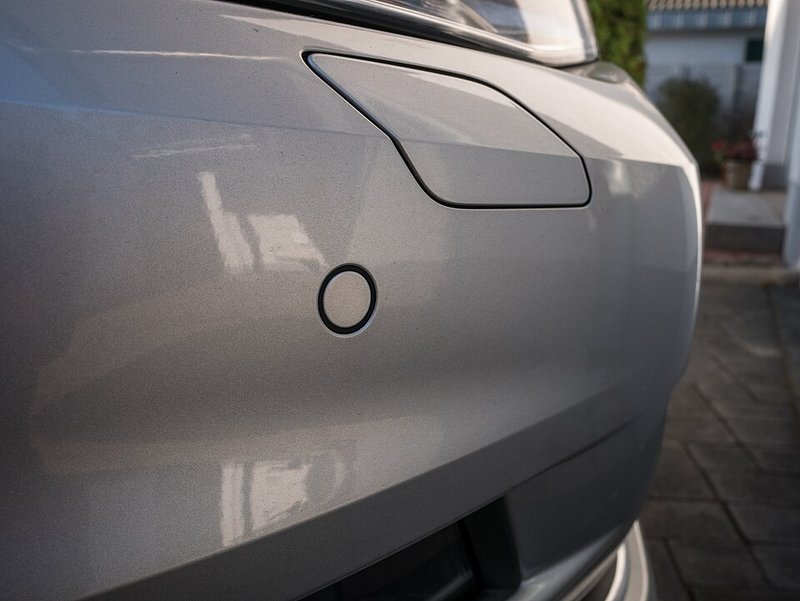
The bumper sensors are both transmitters and receivers. Each sends out a signal (usually ultrasonic). The signal bounces off an object and returns. The computer uses the time taken to return to work out how far away the object is. Many sensors together build a 3D imageof the surroundings.
Advantages (self-parking)
- The same number of cars fit into fewer spaces; smaller gaps can be used.
- Less traffic disruption — parking is quicker and smoother.
- Fewer dents and scratches, so fewer insurance claims.
- Safer: the manoeuvre stops if a new object (a child) appears.
- Very consistent results.
Disadvantages (self-parking)
- Drivers over-rely on it and lose the skill.
- Dirty or faulty sensors send false data — a malfunction.
- Low kerbs may be missed, so wheels get scraped.
- Expensive option, needing extra maintenance.
3 · Example — adaptive cruise control (ACC)
The driver sets a cruising speed, e.g. 100 km/h. Lasers in the bumper send signals constantly. They reflect off the vehicle ahead. The computer uses the return time to calculate the gap. Then it follows the flowchart below.
4 · Agriculture — automatic irrigation of huge fields
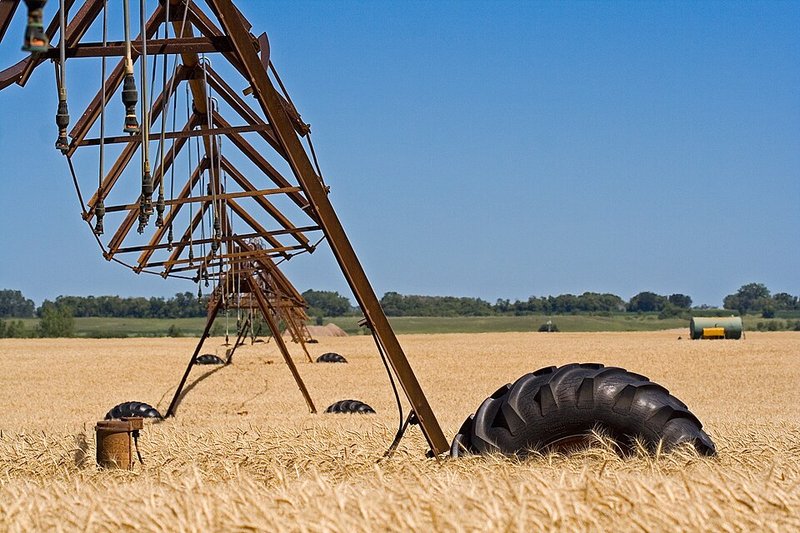
Some farms have fields over 10 km² in hot, remote regions. Walking the water channels is slow and unsafe. So irrigation (watering) is fully automatic, and it relies heavily on wireless transmission.
Advantages (irrigation)
- Lower labour costs — one supervisor covers vast areas.
- Better, more efficient control; precious water is saved.
- Faster response than people checking kilometres of channels.
- Safer — fields can reach 40 °C.
- Different crops can get different watering at the same time.
Disadvantages (irrigation)
- Expensive equipment to set up.
- High maintenance; specialist technicians may be far away.
- A blocked or collapsed channel is not detected — some areas flood, others dry out.
Worked Example 12 min
(a) From echo time to distance
A bumper sensor sends an ultrasonic pulse. The echo returns after 0.006 s. Sound travels at about 340 m/s. How far away is the object?
- Distance the pulse travels in total = speed × time = 340 × 0.006 = 2.04 m.this is the journey there and back.
- Distance to the object = total ÷ 2 = 2.04 ÷ 2 = 1.02 m.the object is only half the round trip away.
- The computer compares 1.02 m with a stored safe gap, e.g. 0.30 m.every decision is a comparison with a stored value.
- 1.02 > 0.30, so it signals the actuators to keep reversing. Below 0.30 it would apply the brakes.state the action for each outcome.
(b) Tracing adaptive cruise control
The driver sets SetSpeed = 100 km/h. The stored SafeDistance = 60 m. Here is the flowchart as Cambridge pseudocode:
Pseudocode · one pass of the ACC loop per reading
CONSTANT SetSpeed ← 100
CONSTANT SafeDistance ← 60
DECLARE Distance, Speed : INTEGER
DECLARE CruiseOn : BOOLEAN
CruiseOn ← TRUE
REPEAT
  INPUT Distance
  INPUT Speed
  IF Distance < SafeDistance
    THEN
      OUTPUT "Brake / reduce throttle"
    ELSE
      IF Speed < SetSpeed
        THEN
          OUTPUT "Increase throttle"
        ELSE
          IF Speed > SetSpeed
            THEN
              OUTPUT "Decrease throttle"
          ENDIF
      ENDIF
  ENDIF
  INPUT CruiseOn
UNTIL CruiseOn = FALSE| Reading | Distance | Speed | Distance < 60? | OUTPUT |
|---|---|---|---|---|
| 1 | 85 | 92 | No | Increase throttle |
| 2 | 70 | 100 | No | (none — speed correct) |
| 3 | 48 | 100 | Yes | Brake / reduce throttle |
| 4 | 75 | 104 | No | Decrease throttle |
- Reading 1: gap 85 is safe, so check speed. 92 < 100 → increase throttle.the distance test always comes first.
- Reading 3: gap 48 < 60 → brake. Speed is not checked on this pass.safety overrides the driver's set speed.
- Reading 4: gap safe, 104 > 100 → decrease throttle.ACC corrects in both directions.
Try It Yourself 12 min
Goal: For the train signal system, the autopilot and the irrigation system, name one sensor and one actuator each.
Goal: Extend the ACC trace with readings (Distance, Speed) = (55, 90), (90, 100), (62, 97). Fill the OUTPUT column.
Goal: A car park photographs each number plate on entry and exit. Describe how sensors, cameras, actuators and a microprocessor raise the barriers and make sure the fee is paid before exit. Then give two advantages and two disadvantages.
Hint
A sensor detects a car at the barrier. The plate read at exit is matched with the plate stored at entry, and with a payment record. Only then does an actuator raise the barrier.
📝 Exam Practice 10 min
State two parts of an aircraft that are moved by actuators when the autopilot is in use.
Mark scheme
- Any two (1 each): wing flaps · throttle · rudder.
Describe how a self-parking car uses sensors, an on-board computer and actuators to park in a space.
Mark scheme
- Sensors / cameras measure the size of parking spaces as the car passes (1).
- Computer tells the driver when a suitable space is found (1).
- Sensors in the bumpers send out signals that reflect off objects and return (1).
- Computer uses the time taken for the signal to return to calculate distances / build a 3D image (1).
- Computer sends signals to actuators to operate steering, brakes and throttle (1).
Explain two advantages and two disadvantages of a self-parking system.
Mark scheme
- Advantage: fits into smaller spaces, so more cars can park in the same area (1).
- Advantage: safer — stops if a new object/person is detected / fewer dents, so fewer insurance claims (1).
- Disadvantage: dirty or faulty sensors give false data, causing a malfunction (1).
- Disadvantage: driver loses parking skills / low kerbs missed / expensive to buy and maintain (1).
A very large farm waters its crops automatically. Describe how the system decides when to switch the water pumps on.
Mark scheme
- (Ultrasonic) water level sensors measure the water in the channels (1).
- Data is sent by wireless transmitters to a receiver / the controller (1).
- Controller also uses data from an (automatic) weather station (1).
- Controller compares data with stored values and signals actuators to start/stop pumps (1).
🗝️ Recap & Key Terms 3 min
Cars, trains and aircraft use the same loop to help a human driver. Bumper sensors time a reflected signal to find distances. ACC checks the gap first, then the speed. Farms combine wireless level sensors with weather data to run their pumps.
- Adaptive cruise control
- Sensors, actuators and a microprocessor keep a vehicle a safe distance behind the vehicle in front.
- Self-parking system
- Bumper sensors and cameras measure the space; the computer drives the steering, brake and throttle actuators.
- Autopilot
- An automated system that uses actuators on the flaps, throttle and rudder to hold height, speed and direction.
- Controller
- A microprocessor that is in control of a process.
- Wireless transmitter / receiver
- Sends sensor data over radio from remote sites to the controller, with no cables.
Homework 1 min
Task (≤ 15 min): A new car can recognise road signs. It reaches roadworks with a 60 km/h limit. Describe how sensors, actuators and the on-board computer keep the car at the correct speed. [5]
Model answer
- A camera captures images of road signs (1).
- The computer recognises the sign by comparing it with signs stored in its database (1).
- A speed sensor sends the car's current speed to the computer (1).
- The computer compares the current speed with the stored limit of 60 km/h (1).
- If too fast, it signals actuators to reduce the throttle / apply the brakes; the check repeats (1).