The Large Motor
The Large Motor is the bigger of the two EV3 motors. It turns more slowly than the Medium Motor but pushes far harder, which is why it drives wheels and lifts loads. If a mechanism struggles or stalls with a Medium Motor, this is usually the answer.
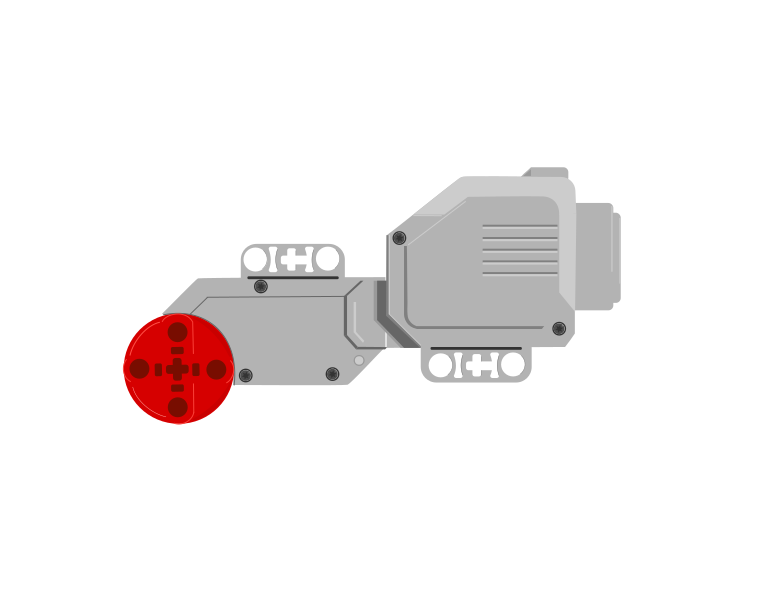 Large Motor
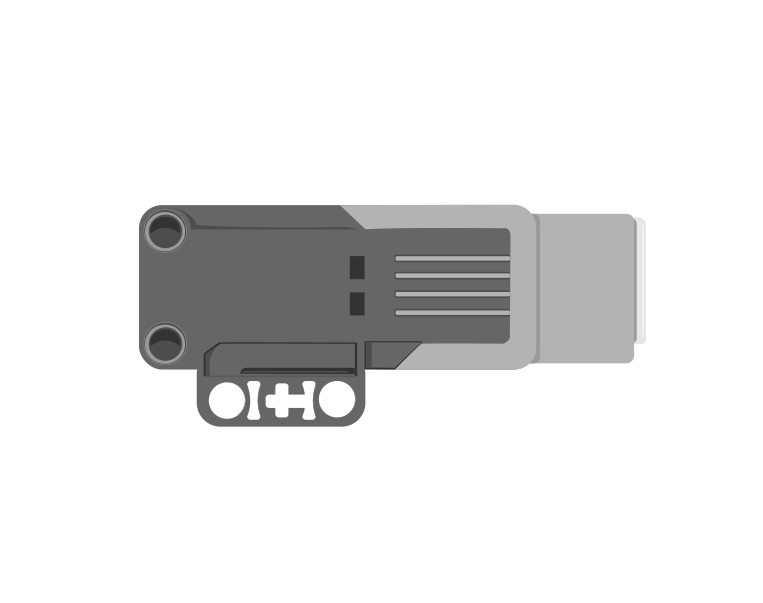 Medium Motor
Blocks reference
| Block | What it does |
|---|---|
[B v] run [clockwise v] for (3) [rotations v] :: motors | Turns the motor a measured amount, then stops. |
[B v] run [clockwise v] for (2) [seconds v] :: motors | Turns it for a length of time rather than a distance, then stops — however far the shaft actually got. |
[B v] set speed to (40) % :: motors | Sets how fast the next movement will be. |
[B v] start motor [clockwise v] :: motors | Starts it turning and carries straight on. |
Watch them race, then watch them lift
Give both motors the same program and the same arm. With nothing on the arm the Medium Motor wins easily — which is why it is tempting to treat it as simply the better motor. Then the demo hangs a weight on both arms and runs it again.
and on the Large Motor, only the port changes
Turning the speed up would not rescue the Medium Motor here — a stalled motor needs more force, which means gearing it down or using the Large Motor.
That is the whole difference. The Medium Motor is quicker; the Large Motor is stronger. A motor that cannot produce enough force does not move slowly — it stops altogether and strains, which is the buzzing, going-nowhere failure almost every LEGO builder meets sooner or later.
A stalled Large Motor hangs the program too
Being stronger buys the Large Motor a bigger load, not an infinite one. Every winch runs out of cable and every lift reaches the top of its rails, and when a motor arrives at a limit it stalls: the shaft stops turning and the motor sits there straining.
That is a problem for the program, not just the mechanism. run for (3) rotations does not finish when three rotations’ worth of time has gone by — it finishes when the shaft has actually turned three times. A winch that reaches the top after two and a half will never report three, so the block waits, and every block after it is unreachable. Nothing crashes. The motor keeps pushing and the rest of the program simply never happens.
The third setting in that dropdown is the way out. for () seconds drives the motor for a duration and then stops regardless, so it always finishes and the program always moves on. Drive into a limit slowly, for a comfortably long time, and then call that position zero:
when program starts :: events hat
[B v] set speed to (30) % :: motors
[B v] run [counterclockwise v] for (3) [seconds v] :: motors
[B v] reset degrees counted :: motors
The lift ends up against its own stop, the encoder is zeroed there, and every measured move afterwards starts from a place you know. The rule is the same for both motors: if the movement ends against something solid, run for seconds; if it ends somewhere in the middle, measure it. The Medium Motor module has the animation for it — see The Medium Motor, which is where this bites hardest, because a Medium Motor is usually the one doing the lifting.
Which motor for which job
- Large Motor — wheels, winches, anything lifting weight. Strong, slower. Normally ports B and C.
- Medium Motor — arms, gates, jaws, pointers. Quick, lighter. Normally ports A and D.
The blocks are identical apart from the port letter, so swapping one motor for the other is a build change, not a programming change.
Why it matters
Real machines match the motor to the load. A lift uses a powerful, slow motor; the button panel beside it uses tiny ones. Choosing the wrong size is the most common reason a LEGO mechanism whines but does not move.
More motion tutorials
- One motor, on and off — Start one motor, let it run, and stop it again.
- The Medium Motor — The small, fast motor that drives arms, gates, jaws and winches.
- Driving with two motors — Drive a robot in a straight line, and turn it, using two Large Motors.
- Rotations and degrees — Measure how far a motor turns, so the same movement repeats exactly.
- Speed and power — Make a motor go faster or slower.
- Brake or coast — Stop a motor dead, or let it roll to a halt.
- Moving to an exact angle — Send a motor to an exact position instead of a distance from here.