Brake or coast
Telling a motor to stop does not say how it should stop. There are two very different behaviours, and which one you want depends entirely on what the mechanism is holding up.
- Brake — the motor actively holds its position. A lifted arm stays lifted; a robot stops dead where it is.
- Coast — the motor lets go. A lifted arm sags under its own weight; a moving robot rolls on a little before stopping.
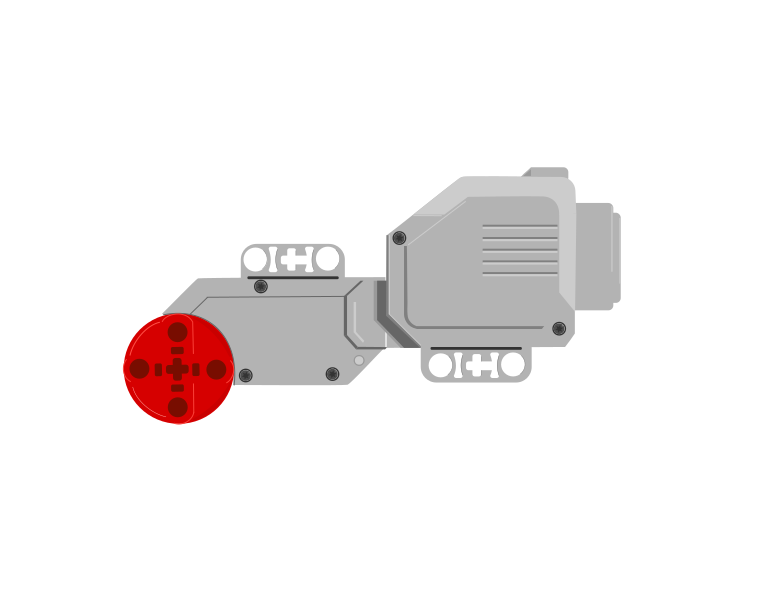
Watch what happens after the stop
Both arms below are lifted by the same program and stopped at the top. The only difference is one word in the stop block. Everything worth seeing here happens after the movement has finished.
the only change on the other arm
If a mechanism you just lifted sags the moment it stops, the stop action is the first thing to check — not the lifting movement.
The coasting arm does not slide down steadily — it starts slowly and picks up speed, because it is gravity pulling it and not a motor lowering it. That is also why a coasting robot rolls a little past where its measured movement ended.
Which to choose
If gravity is pulling on the mechanism, you almost always want brake — otherwise the thing you just lifted comes back down on its own. If you want a smooth, natural halt, or you want to be able to push the robot by hand afterwards, coast is friendlier.
Coasting also makes a robot travel slightly further than its measured movement, because it keeps rolling after the motor has finished. On a precise task that error matters.
Why it matters
A crane must brake — a coasting crane drops its load. A train coasts into a station rather than stopping dead, because passengers would be thrown forward. The same choice, made differently, for good reasons.
More motion tutorials
- One motor, on and off — Start one motor, let it run, and stop it again.
- The Medium Motor — The small, fast motor that drives arms, gates, jaws and winches.
- The Large Motor — The big, strong motor used for wheels and heavy lifting.
- Driving with two motors — Drive a robot in a straight line, and turn it, using two Large Motors.
- Rotations and degrees — Measure how far a motor turns, so the same movement repeats exactly.
- Speed and power — Make a motor go faster or slower.
- Moving to an exact angle — Send a motor to an exact position instead of a distance from here.